1. What Is a Document Intelligence App?
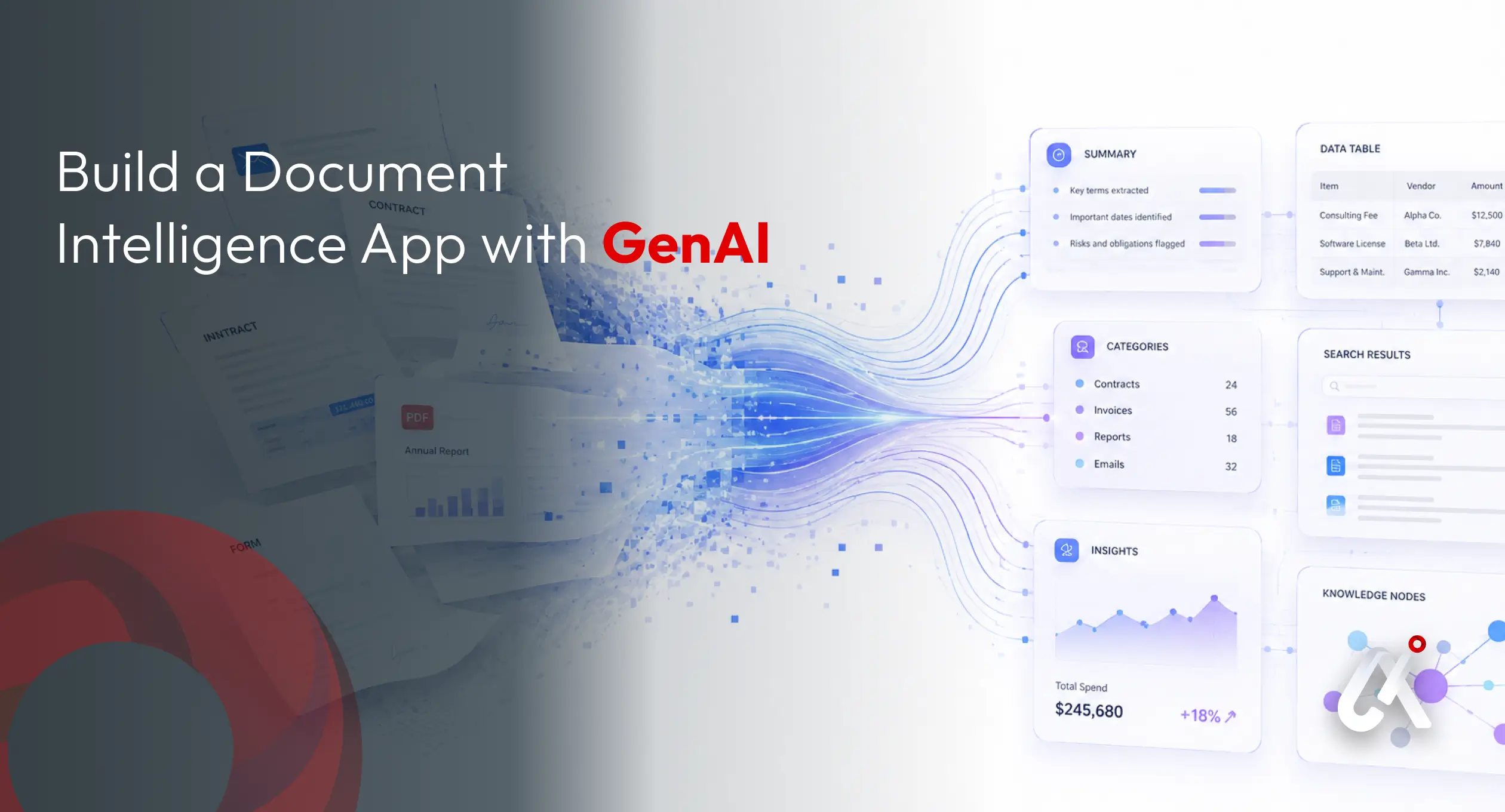
A document intelligence app is an AI-powered system that reads, understands, classifies, extracts, and reasons over unstructured documents — PDFs, contracts, invoices, reports, emails, and more — at scale, without manual human effort.
Traditional document processing relied on rule-based OCR or template matching, which breaks the moment document formats change. Generative AI flips this model entirely: instead of programming rules, you train or prompt a large language model (LLM) to understand context, intent, and structure just as a human reader would.
For businesses processing hundreds or thousands of documents a day, this is a game-changing efficiency unlock — reducing processing time from hours to seconds, while dramatically improving accuracy.
2. Why Generative AI Is the Right Foundation
Legacy NLP tools can extract keywords. Generative AI models — particularly large language models like GPT-4, Claude, and Gemini — can understand meaning, summarize complex clauses, answer questions from document content, and flag anomalies in context.
Here’s what makes generative AI uniquely suited for document intelligence:
- Contextual comprehension: understands nuance, not just keywords
- Zero-shot capability: works on new document types without retraining
- Multi-modal support: processes text, tables, images, and mixed-format files
- Conversational interface: lets users ask questions about documents naturally
- Scalability: processes thousands of documents simultaneously via API
If your team is evaluating whether to build a custom AI solution or adopt an off-the-shelf tool, document intelligence is one of the strongest ROI cases for custom development — especially when your documents are domain-specific.
3. Core Components of a Document Intelligence System
Understanding the architecture before you build ensures you make the right technology decisions early. Here are the five essential layers:
| Layer | Purpose |
|---|---|
| Document Ingestion | Accepts PDFs, DOCXs, images, emails; normalizes format for downstream processing |
| OCR & Parsing | Converts scanned/image documents into machine-readable text using vision models or OCR engines |
| LLM Reasoning Layer | Processes text using a large language model for extraction, summarization, classification, and Q&A |
| Vector Database | Stores document embeddings for semantic search and RAG (Retrieval-Augmented Generation) |
| Output & Integration | Delivers results via API, dashboard, webhook, or integrates with CRMs, ERPs, and business tools |
4. Step-by-Step: How to Build a Document Intelligence App
Step 1: Define Your Document Scope
Start by cataloguing your document types: invoices, contracts, medical records, legal briefs, or something else? Each type requires slightly different extraction logic, output schemas, and validation rules. The clearer this scope, the better your LLM prompts and fine-tuning strategy will be.
Step 2: Choose Your Ingestion & OCR Stack
For native digital documents (PDFs with text layers), standard parsing libraries suffice. For scanned documents or images, integrate a vision-capable model or an OCR tool like Tesseract, AWS Textract, or Google Document AI. If your documents include tables and forms, a vision-language model (VLM) will outperform text-only OCR.
Step 3: Set Up a RAG Pipeline
Retrieval-Augmented Generation (RAG) is the architectural backbone of most generative AI document apps. Documents are chunked, embedded using an embedding model, and stored in a vector database (Pinecone, Weaviate, pgvector). When a user query arrives, the system retrieves relevant chunks and passes them to the LLM with the question — enabling accurate, grounded answers rather than hallucinations.
Aipxperts builds robust RAG pipelines as part of our LLM development services, tailored to your document structure and query patterns.
Step 4: Prompt Engineering & Fine-Tuning
For general document types, well-crafted prompts with few-shot examples are often sufficient. For highly specialized domains (legal, medical, financial), fine-tuning a smaller model on your labeled dataset yields better accuracy and lower inference costs.
Step 5: Build the Output Layer
Define what your app delivers: structured JSON for downstream systems, a chatbot interface for end users, an automated email summary, or a dashboard with extracted KPIs. This determines your API design, frontend requirements, and integration touchpoints.
Step 6: Evaluate, Monitor & Iterate
Measure extraction accuracy, hallucination rate, and latency. Use human-in-the-loop review for edge cases in early deployment. Set up feedback loops so your model improves with production data.
💡 Need expert guidance on architecture decisions?
Our team has delivered 300+ AI projects. Get a free consultation → aipxperts.com/ai-consulting-services/
5. Key LLM Technologies Behind the Hood
The choice of underlying technology significantly impacts performance, cost, and control. Here’s what powers modern document intelligence apps:
- Large Language Models (LLMs): GPT-4o, Claude 3, Gemini 1.5 — for reasoning, extraction, summarization
- Embedding Models: OpenAI text-embedding-3, Cohere Embed — convert text to vector representations for semantic search
- Vision-Language Models: GPT-4 Vision, LLaVA — handle scanned docs, charts, handwritten notes
- Vector Databases: Pinecone, Weaviate, ChromaDB, pgvector — enable fast semantic retrieval
- Orchestration Frameworks: LangChain, LlamaIndex — manage RAG pipelines, memory, and tool use
Our team at Aipxperts stays at the forefront of these technologies through our dedicated generative AI development practice, ensuring you get the best-fit stack for your specific use case and budget.
6. Common Use Cases by Industry
Document intelligence isn’t a single-industry solution — it’s a horizontal capability with deep applications across verticals:
- Legal & Compliance: Contract review, clause extraction, risk flagging, due diligence automation
- Finance & Banking: Invoice processing, KYC document verification, audit trail extraction, loan underwriting
- Healthcare: Medical record summarization, insurance claim processing, clinical note extraction
- Logistics & Supply Chain: Shipping manifest parsing, customs document processing, vendor invoice automation
- HR & Recruitment: Resume parsing, policy document Q&A, onboarding document processing
Aipxperts has deep expertise across several of these domains — explore our AI agent development services to see how autonomous document agents are transforming business workflows.
7. Challenges & How to Overcome Them
Building a production-grade document intelligence app involves challenges that differ significantly from a proof-of-concept. Here are the most critical ones:
Hallucination and Accuracy
LLMs can confidently produce wrong answers. Mitigate with RAG (grounded retrieval), confidence scoring, and structured output schemas that force the model to cite source passages.
Document Variability
Real-world documents are messy — inconsistent layouts, handwriting, tables spanning pages. Use vision models and robust chunking strategies to handle variety.
Data Privacy and Compliance
Documents often contain PII and sensitive data. Implement PII redaction pre-processing, use private/self-hosted LLM deployments where required, and ensure GDPR/HIPAA compliance in your architecture.
Latency at Scale
Processing large document volumes in real time requires async processing pipelines, caching strategies, and efficient chunking. Design for scale from day one.
8. Q&A: Frequently Asked Questions
9. Conclusion: Your Next Step Toward Document Intelligence
Document intelligence powered by generative AI is no longer an emerging concept — it’s a production-ready capability that forward-thinking businesses are deploying right now to eliminate manual document processing, accelerate decision-making, and unlock data trapped in unstructured formats.
The path to building one is clear: define your document scope, stand up a solid ingestion and RAG pipeline, choose the right LLM for your use case, and build iteratively with real user feedback. The ROI — in time saved, errors eliminated, and operational speed gained — is measurable and fast.
The question isn’t whether your business needs document intelligence. The question is: how fast can you move?
Aipxperts is a dedicated AI development company with 300+ delivered projects and deep expertise in generative AI, LLM applications, and custom AI-powered software. Whether you need a proof-of-concept or a full production system, our team can take you from idea to deployment — fast.
Ready to build your Document Intelligence App?
Contact Aipxperts today for a free scoping session