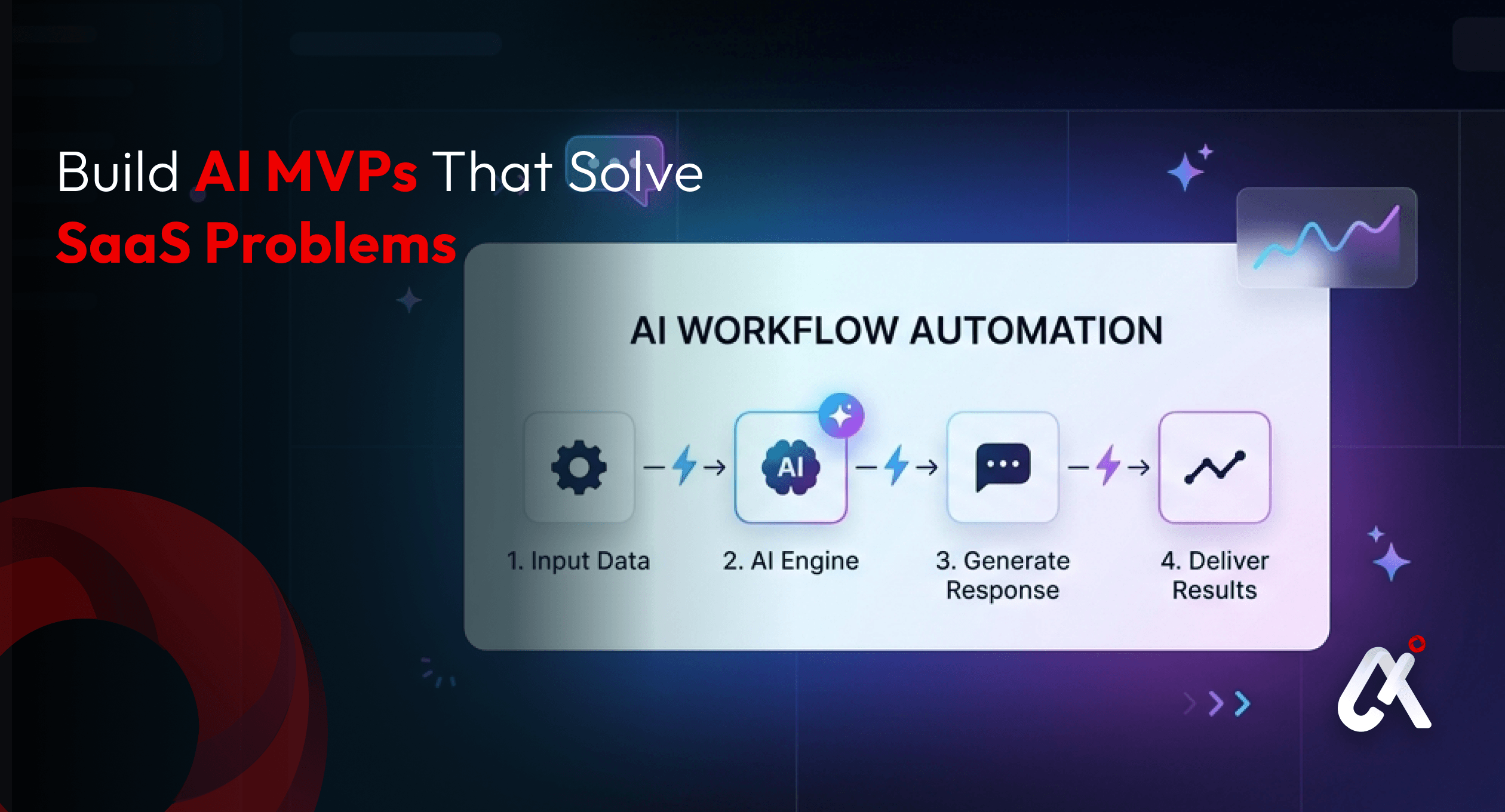
Every week, hundreds of SaaS teams ship AI features that users quietly ignore. The dashboards look impressive in demos. The press releases use words like “intelligent” and “automated.” But the product metrics tell a different story: low adoption, high churn from the feature, and a development team wondering where they went wrong.The problem is rarely the AI. The problem is that the team built what was technically interesting instead of what was genuinely painful for the customer to live without.
This guide is a practical, step-by-step framework for SaaS founders, CTOs, and product managers who want to build an AI MVP that does one thing extraordinarily well: solve a real, validated, revenue-relevant problem for a real SaaS customer. We will cover how to discover the right problem, choose the right AI architecture, build the thinnest possible version that still creates measurable value, and iterate toward product-market fit.
At Aipxperts, we have delivered more than 300 AI-driven products for SaaS companies across the USA, Malaysia, Spain, and India. The playbook below reflects what actually works — including the expensive lessons.
1. What Is an AI MVP and Why Does It Matter for SaaS?
A Minimum Viable Product (MVP) is the leanest version of a product that can be put in front of real customers to
generate validated learning. An AI MVP applies that same principle to an AI-powered feature or product: it is
the smallest, fastest-to-build version of an AI system that can demonstrate real value to a target user.
In the SaaS context, an AI MVP might be:
- A customer support chatbot trained on your knowledge base that deflects the top 20 support ticket
categories - A churn prediction model surfaced inside your product dashboard that flags at-risk accounts 30 days
before renewal - An LLM-powered writing assistant embedded in a project management tool that drafts status updates from
task data - An AI agent that automatically triages incoming leads and routes them to the correct sales
representative
What an AI MVP is NOT:
- A fully trained, production-grade model with 99% accuracy from day one
- An AI feature built because a competitor has one
- A generative AI integration added to a product roadmap because investors asked about AI strategy
The critical insight for SaaS teams is this: your AI MVP must solve a problem that your customer already
experiences as painful enough to change their behaviour. If the AI saves five minutes on a task the user only
does once a month, adoption will be near zero. If the AI eliminates 45 minutes of daily friction, you have a
product.
If you are still in the exploration phase, AI consulting services can help you identify where AI actually
creates leverage in your product and business model before you commit to building anything.
Step 1: Identify Real SaaS Customer Pain Points Before You Build
The single most important step in AI MVP development is also the most frequently skipped: deep, unbiased
discovery of the problem you are solving.
1.1 Talk to Your Customers (Seriously)
Most SaaS teams say they do customer discovery. Very few do it in a way that surfaces the problems customers
actually experience versus the problems they are willing to voice in a sales call or NPS survey. For AI MVP
discovery, you need to go deeper.
The following approaches consistently surface high-value AI opportunities:
- Session replays and heatmaps: Where do users stall, rage-click, or abandon flows? These are friction
points that AI can potentially eliminate. - Support ticket taxonomy: Categorise your last 500 support tickets. The top categories by volume are your
best AI candidates — if they are repetitive and data-driven. - Jobs-to-be-done interviews: Ask customers not what features they want, but what jobs they are trying to
accomplish and what “hires” them when they can’t get those jobs done inside your product. - Time-tracking analysis: Ask five customers to log where they spend time inside and around your product
for one week. The tasks that take disproportionate time relative to their importance are prime AI
targets.
1.2 Score Pain Points Against an AI Readiness Matrix
Not every customer pain point is solvable with AI, and not every AI-solvable problem is worth building for. Use
a simple scoring matrix to prioritise:
| Pain Point Criteria | Score (1-5) | AI Feasibility (1-5) | Priority |
|---|---|---|---|
| High frequency (daily use) | 5 | 5 | Critical |
| Data-rich and structured | 4 | 5 | High |
| Currently manual and rule-based | 4 | 4 | High |
| High cost of error for the user | 3 | 3 | Medium |
| Requires human judgment primarily | 2 | 2 | Low |
| Rare edge case scenario | 1 | 2 | Skip |
The sweet spot is a pain point that is high-frequency, currently handled by humans following rules or templates,
and where a wrong AI output is recoverable (not catastrophic).
1.3 Validate the Problem Has Commercial Weight
Before you write a single line of code, answer these questions:
- Is this pain point mentioned in churn interviews? If customers leave because of this problem, solving it
has direct revenue impact. - Would solving this problem allow you to charge more, convert more trials, or retain customers longer? If
the answer to all three is no, reconsider priority. - Is a competitor already solving this with AI? If yes, that validates the market — but you need to solve
it meaningfully better or cheaper.
Ready to validate your AI idea with real market data? Speak with an Aipxperts AI consultant today. →
https://aipxperts.com/ai-consulting-services/
Step 2: Define the Minimal Intelligence Needed to Solve the Problem
One of the most expensive mistakes in AI MVP development is over-engineering the intelligence. A team discovers
a real problem, gets excited about AI, and then spends six months building a sophisticated custom model when a
much simpler solution would have delivered 90% of the value in six weeks.
2.1 The AI Complexity Ladder
Before choosing a solution, locate your problem on the AI complexity ladder:
| Level | Approach | Timeline | Best For |
|---|---|---|---|
| 1 | Rules + simple classification | 1-2 weeks | Ticket routing, basic tagging |
| 2 | Pre-trained LLM via API (GPT-4, Claude) | 2-4 weeks | Summarisation, drafting, Q&A |
| 3 | RAG (Retrieval-Augmented Generation) | 4-8 weeks | Knowledge-base chat, doc analysis |
| 4 | Fine-tuned LLM on proprietary data | 8-16 weeks | Domain-specific generation |
| 5 | Custom model training from scratch | 6+ months | Rare; only for unique data advantages |
For most SaaS AI MVPs, the answer lives at Level 2 or Level 3. A well-promted GPT-4 or Claude integration with
your product data, delivered through a clean UI, will outperform a mediocre custom model every single time.
If your problem requires deep domain language understanding — medical, legal, logistics — then a custom LLM
development approach with fine-tuning on your proprietary data is worth the investment. But only after the
simpler version has proven value with users.
2.2 Define the AI’s Job in One Sentence
Every AI MVP needs a single, unambiguous job description. If you cannot describe what your AI does in one
sentence without using the word “intelligent,” you have not defined it clearly enough.
Good: “This AI reads incoming support tickets, classifies them into one of 12 categories, and
routes each to the correct team queue.”
Good: “This AI analyses the last 90 days of product usage data for each account and generates a
plain-English health summary every Monday.”
Bad: “This AI intelligently enhances the customer experience through automated insights.”
The one-sentence job description becomes your acceptance criteria, your user story, and your out-of-scope
filter. If a feature or capability is not in that sentence, it does not go in the MVP.
Step 3: Choose the Right AI Architecture for Your MVP
The architecture decision for an AI MVP has more long-term impact than almost any other technical choice. The
wrong architecture creates technical debt that is painful and expensive to unwind later.
3.1 LLM API Integration (The Fast Path)
For most SaaS AI MVPs in 2025 and 2026, the fastest and most pragmatic path is integrating a pre-trained LLM via
API — OpenAI GPT-4, Anthropic Claude, or Google Gemini — combined with well-structured prompts and your product
data.
This approach is appropriate when:
- Your core task involves language: writing, summarising, classifying, answering questions, or extracting
structured data from text - You need to ship in under eight weeks
- Your data is not so sensitive that it cannot leave your infrastructure (or you use on-premise
deployment) - You are still validating whether users will actually adopt the AI feature
Aipxperts builds LLM-powered SaaS features using this approach regularly. Our generative AI development services
team can have a working prototype in your staging environment within two to four weeks.
3.2 RAG Architecture for Knowledge-Intensive SaaS
If your AI MVP needs to answer questions about your specific product, your customers’ data, or your company’s
knowledge base, Retrieval-Augmented Generation (RAG) is the right architecture.
In a RAG system, the LLM does not need to memorise your data. Instead, it retrieves the most relevant documents
or records at query time and uses them as context to generate accurate, grounded answers. This is critical for
SaaS use cases like:
- Customer-facing documentation bots that answer product questions accurately
- Internal knowledge assistants for support agents
- Account health summaries generated from CRM and usage data
- Contract analysis tools for legal or compliance SaaS
3.3 AI Agents for Workflow Automation
If the problem you are solving requires multiple steps, tool use, or decision-making across systems, an AI agent
architecture may be appropriate even at MVP stage.
An AI agent can browse your product database, send notifications, update records, call external APIs, and chain
together complex workflows — all triggered by a single user instruction. For SaaS products with automation at
their core (workflow tools, CRM platforms, project management systems), an agent MVP can be transformative.
The key constraint for agent MVPs: limit the agent’s scope tightly. An agent that can do one three-step workflow
reliably is more valuable than an agent that can attempt fifty workflows unreliably.
Not sure which AI architecture fits your SaaS product? Get a free technical assessment from the
Aipxperts team. → https://aipxperts.com/contact-us/
Step 4: Build Fast — The AI MVP Development Workflow
Speed is not the enemy of quality in an AI MVP. Speed is the mechanism by which you find out whether your
assumptions are right before you invest heavily in the wrong direction.
4.1 The Two-Week Sprint Structure
Aipxperts uses a structured two-week sprint framework for AI MVP delivery. Here is the standard sequence:
| Sprint | Focus | Deliverable |
|---|---|---|
| Sprint 0 (Week 1) | Discovery, data audit, architecture decision | Technical spec + data readiness report |
| Sprint 1 (Weeks 2-3) | Core AI integration + API scaffolding | Working AI endpoint with test inputs/outputs |
| Sprint 2 (Weeks 4-5) | UI integration + basic user flow | Internal demo-ready prototype |
| Sprint 3 (Weeks 6-7) | User testing + iteration on prompts/model | Beta version with 5-10 real user feedback sessions |
| Sprint 4 (Week 8) | Performance optimisation + monitoring setup | Production-ready AI MVP with analytics |
4.2 Data Readiness: The Hidden Blocker
The number one reason AI MVP projects stall is not the AI — it is the data. Before you begin development, audit
your data against these criteria:
- Volume: Do you have enough historical examples for the AI to learn from or retrieve
from? For LLM API integrations, volume matters less; for fine-tuning, you typically need at least 1,000
to 10,000 examples. - Quality: Is the data labelled, structured, and clean? Garbage data produces garbage AI.
- Accessibility: Is the data in a format and location your development team can actually
use? Data locked in PDFs, legacy databases, or third-party systems with no API needs extraction work
first. - Freshness: For real-time AI features, is the data pipeline live and reliable?
4.3 Prompt Engineering Is a Product Skill
For LLM-based AI MVPs, the quality of your prompts is as important as the quality of your code. Treat prompt
engineering as a product design discipline:
- Write prompts that specify the AI’s persona, task, constraints, and output format explicitly
- Test prompts against adversarial inputs before going to users
- Version-control your prompts as rigorously as you version your codebase
- Build a prompt evaluation framework so you can measure when a prompt change improves or degrades quality
Our AI development services team integrates prompt engineering, model selection, and full-stack development in a
single workflow — so you get a production-quality AI feature, not a demo.
4.4 UI/UX for AI Features: Different Rules Apply
AI features require different UX patterns than traditional software features. The core challenge is managing
user expectations around AI reliability:
- Show confidence signals: If the AI classifies a ticket with 95% confidence, show that.
If it is 60%, surface the uncertainty so the user can review. - Make it easy to correct the AI: Users who can quickly override or correct AI outputs
trust the system more, not less. An “Edit” button is a feature. - Explain the AI’s reasoning where possible: “This account was flagged as at-risk because
login frequency dropped 70% in the last 14 days” is far more useful than “At-risk account.” - Design for the cold-start problem: New accounts have no historical data. Your AI needs
graceful fallbacks for users with thin data profiles.
For end-to-end product design that integrates AI features seamlessly, our UI/UX design team works alongside AI
engineers from day one.
Step 5: Validate With Real Users and Measure What Matters
Shipping the AI MVP is not the finish line. It is the starting gun. The goal of an MVP is to generate validated
learning, and that means measuring whether the AI is actually solving the problem you set out to solve.
5.1 The Three Metrics That Matter for AI MVPs
| Metric | What It Measures | Target for a Healthy AI MVP |
|---|---|---|
| AI Task Completion Rate | % of times AI successfully completes its defined job | Above 80% before expanding scope |
| Feature Adoption Rate | % of target users who use the AI feature weekly | Above 40% within 60 days of launch |
| Time-to-Value Reduction | How much time the AI saves users per use | At least 50% reduction vs. manual process |
Do not optimise for AI accuracy in isolation. An AI that is 97% accurate on a task that users do not care about
is a failed product. An AI that is 82% accurate on a task users do 10 times a day and find genuinely useful is a
successful product.
5.2 Qualitative Signals Are Equally Important
Watch for these qualitative indicators that your AI MVP is working:
- Users complain when the AI feature is down or slow — this signals dependency, which is the highest form
of adoption - Users share AI outputs with colleagues or export them for use in other tools
- Support tickets shift from “how do I do X manually” to “the AI did X incorrectly” — the latter means
users trust the AI enough to rely on it
5.3 Iterate on the Model, Not the Problem
If adoption is low, the instinct is to add more AI capabilities. Usually the right move is to go deeper on the
original problem, not wider. Ask:
- Is the AI output format wrong for how users work? Changing a paragraph summary to a bullet list
sometimes doubles adoption. - Is the AI triggered at the wrong point in the workflow? The same AI feature can fail at step 3 of a
workflow and succeed at step 1. - Is there a trust deficit? Can you add explainability, confidence scores, or an easy correction mechanism
to build user confidence?
Building your first AI MVP? Aipxperts delivers production-ready AI MVPs in 6-8 weeks. Explore our MVP
Development services. → https://aipxperts.com/mvp-development/
Common AI MVP Mistakes SaaS Teams Make (And How to Avoid Them)
Building the AI Before Validating the Problem
The most common and costly mistake. The team is excited about an AI capability, builds it for four months,
and discovers at launch that customers do not find it useful enough to change their behaviour. Discovery
comes before development. Always.
Treating the LLM as the Product
The LLM is infrastructure, not a product. GPT-4, Claude, or Gemini alone is not your moat. Your moat is the
workflow integration, the proprietary data, the UX, and the domain-specific prompt engineering that makes
the AI useful for your specific customer in your specific context.
Ignoring Latency and Cost at MVP Stage
A demo that makes a call to GPT-4 with a 10-second response time looks fine in a pitch. In production, users
abandon after three seconds. Build latency measurement into your MVP testing framework from the start.
Similarly, AI API costs can scale unexpectedly — model your per-user, per-month cost at 10x, 100x, and 1000x
your current user base before you price the product.
Not Having a Human-in-the-Loop for High-Stakes Outputs
For SaaS products where the AI output directly affects a customer’s business decision — financial forecasts,
medical summaries, legal document analysis — always build a human review step into the MVP. Not because AI
is unreliable, but because trust is earned incrementally and regulatory compliance often requires it.
Skipping Observability
If you cannot see what your AI is doing in production, you cannot improve it. From day one, log every AI
request, response, user rating, and correction. This data becomes the training signal for your next model
iteration and the evidence you need to justify continued investment in the feature.
Our ChatGPT development services team includes observability and prompt monitoring as standard deliverables
— not afterthoughts.
FAQ: AI MVP Development for SaaS
MVP adds a second layer of validation: it also tests whether the AI can perform the task reliably enough
to create real user value. AI MVPs require an additional feedback loop for model performance that
traditional MVPs do not have. Both should be built around a validated user problem, not a technology
capability.
4 to 8 weeks. An AI MVP using a RAG architecture or fine-tuned model typically takes 8 to 16 weeks.
Custom model development from scratch can take 6 months or more. At Aipxperts, most SaaS AI MVPs are
production-ready in 6 to 8 weeks using our structured sprint methodology.
the base model provides the intelligence and you shape its behaviour through prompting and retrieval.
RAG architectures require a document corpus, but it can be as small as 50 to 200 well-structured
documents. Fine-tuning a model typically requires 1,000 to 10,000 labelled examples. The key is to match
your architecture to your data reality, not to your AI ambitions.
with a clean UI typically costs between $15,000 and $40,000. A RAG-based knowledge assistant with CRM
integration typically costs $30,000 to $80,000. An AI agent with multi-step workflows and custom model
fine-tuning can cost $60,000 to $150,000 or more. Ongoing costs include LLM API usage fees, which scale
with user volume.
engineers who are scarce and expensive. An external partner gets you to market faster, reduces hiring
risk, and brings experience from multiple AI projects. The best approach for most SaaS companies is a
hybrid: partner for the MVP to validate the concept quickly, then hire internal AI talent to own and
scale the product once product-market fit is confirmed.
the leading choices for language tasks. Google Gemini is competitive especially for multimodal use
cases. For embeddings and semantic search, OpenAI text-embedding-3 and Cohere Embed are strong
performers. For on-premise or privacy-sensitive deployments, Llama 3 and Mistral are leading open-weight
options. The best model depends on your specific task, latency requirements, and data sensitivity.
given. The primary mitigation strategies are: use RAG to ground responses in retrieved facts; constrain
the output format tightly through prompting; add confidence thresholds so low-confidence outputs are
flagged for human review; implement output validation layers that check AI responses against known data
before surfacing them to users; and build user correction mechanisms that feed back into model
improvement.
Conclusion: Build the AI Your Customer Can’t Live Without
The SaaS companies winning with AI in 2026 are not the ones with the most sophisticated models. They are the
ones that found the most painful problem in their customer’s workflow, built the thinnest possible AI solution
that reliably solves it, and then iterated relentlessly based on real usage data.
The framework is straightforward even if the execution is hard: discover before you build, define the minimal
intelligence needed, choose the right architecture for your problem, ship fast, measure honestly, and iterate on
depth before breadth.
Book a free 30-minute AI strategy session with the Aipxperts team
We’ll assess your SaaS product, identify the highest-value AI opportunities, and outline what a production-ready AI MVP looks like for your specific use case.