AI Agent Development Services, Built to Act Within Limits You Set
We design, build and integrate AI agents that act inside your systems: enumerating what each one may do, wiring it to your CRM, helpdesk or ERP, and shipping it with a spend cap, an approval gate a person controls and its own service account rather than a borrowed login. An agent that answers badly is embarrassing; an agent that acts badly has done something, so every build starts at the lowest level of authority that solves the problem.
Scope an Agent Safely 5.0
5.0 5.0
5.0 4.3
4.3 4.8
4.8Why AI Agent Development Is a Different Kind of Build
Every other AI build produces output somebody reads. This one produces changes in systems, and that single difference reorders the whole engagement.
Ask what a chatbot risks and the answer is a wrong sentence. Ask what an agent risks and the answer depends entirely on what you connected it to. A system that can read a mailbox, update a record and trigger a payment has three different blast radii, and the third one is why this kind of build needs an unusual amount of design before any capability work.
So the sequence here runs backwards from the market norm. What may it reach, under whose identity, with what limit, and what stops it. Those four settle before anybody builds the interesting part. Suppliers who demonstrate capability first and discuss controls at the security review have chosen an order that suits the demo rather than the deployment.
If the rules can actually be written down · If it only has to answer rather than act
Our AI Agent Team, in Numbers
The engineers and delivery record behind the agent work described here.
60+
AI Engineers
50+
AI Solutions Delivered
80+
AI-Integrated Workflows
30+
Industries Served
95%
Client Retention
Our AI Agent Development Services, Ordered by How Much They Can Break
These services are arranged from least to most consequential, because that is the order we recommend taking them in. Most engagements should stop well short of the far end, and a supplier who always reaches it is selling rather than advising.
AI Agent Strategy and Feasibility Consulting
We map the workflow you want automated, enumerate what an agent would need to reach, and name the worst plausible action before anything is built. You get a scope with the blast radius written down, or an honest redirect: a meaningful share of these become integration or rule-based automation projects, which cost less and fail less often.
Custom AI Agent Design and Development
We build the agent at the lowest level of authority that solves your problem, and we start deliberately low. Read-only agents gather, summarise and recommend without changing anything. Draft-and-approve agents prepare the action and a person commits it. Bounded action agents complete an explicitly enumerated set under a spend or volume cap. Most programmes should begin at the first, and several should stay there.
Agentic Workflow Automation
We automate multi-step processes end to end, where the deciding is quick and the doing is manual: reading from one system, judging, then acting in another. The enumerated action list and the approval points are agreed with you before any capability work starts.
AI Agent Integration With Your Systems
We connect the agent to your CRM, helpdesk, ERP or internal APIs with scoped permissions, its own service identity and a per-action audit record. This is the work that sets the blast radius, and everything else depends on how narrowly it is done.
Agentic AI Testing and Evaluation
We build test suites covering both what the agent should complete and what it must decline, run against every model and prompt change. Refusal correctness is measured alongside task success, because tuning a system toward acting is the easiest way to break it quietly.
Guardrails, Monitoring and Kill Path Design
We implement spend caps, rate limits and approval thresholds in code rather than in a prompt, plus a documented stop mechanism that has been tested rather than described. Live monitoring covers what the agent attempted, including the actions it was blocked from taking.
AI Agent Lifecycle Management
We expand the action list after launch against evidence from the log rather than against a plan, re-run the evaluation suite when a provider changes behaviour, and review accumulated permissions on a schedule. Agent permissions creep the same way human ones do, and nobody thinks to check.
AI Agent Projects We Have Delivered, and How Far Each Was Allowed to Go
Look at where each engagement stopped on the scale from read-only to bounded action. Several stopped earlier than the client originally asked for, and that is the interesting part of the record.
Marketplace
Building the AI Layer Behind a Live Marketplace Without Touching Checkout
The marketplace was already live and taking payments, which ruled out rebuilding it. The AI layer runs as a separate FastAPI service, so models can change without redeploying the code that handles checkout.
Read case study: Building the AI Layer Behind a Live Marketplace Without Touching CheckoutLogistics
Serial-Level Tracking for Reusable Cable Reels, From Pickup Request to Invoice
Reusable assets only earn the name if you know where they are. This US recycling operator ran the entire pickup-to-invoice cycle on phone calls, spreadsheets and manual entry, with no trail on a single crate.
Read case study: Serial-Level Tracking for Reusable Cable Reels, From Pickup Request to InvoiceClient Verdicts Once the Agent Is Live
Published on platforms that verify an engagement before a review goes live.

We have contracted a developer from Aipxperts now for several months, based on a referral. We have been very pleased with the quality of the work, the knowledge and skill level of our developer, and the value we're receiving for our fee. We also very much appreciate that the development team works at night (effectively), so we are sometimes able to turn client requests around in a day.There have been a couple of situations where we needed urgent help outside of our developer's normal business hours, and we've received that help (for which I am very grateful). While we have some challenges with communication sometimes, our overall satisfaction level is very high.

Our experience working with Aipxperts has been exceptionally satisfying. From start to finish, they handled the project with professionalism and responsibility. Communication was seamless, and they effectively addressed our requirements, delivering high-quality results on time. Their technical expertise was particularly impressive, as they effortlessly solved complex problems. We highly recommend Aipxperts for their outstanding service and dedication to client satisfaction.
Industry Limits on What an AI Agent May Do
What we build changes very little by sector. What changes is the shortest list of actions anybody will sign off, and agreeing that list is the project. Each entry names the agent work we most often deliver in that industry and the limit it runs under.
Fintech and financial services
Read-only and draft-and-approve, almost without exception. Anything that moves money or alters a customer record needs a person committing it, and in fintech and financial services the audit requirement makes the per-action log the deliverable rather than a feature.
Logistics and warehousing
Exception handling across carrier portals and documents that belong to third parties. Bounded action works in logistics and warehousing because the actions are enumerable and the worst case is a re-booking rather than a loss.
Healthcare administration
Scheduling, records requests and correspondence, where the action list is short by necessity and anything touching a clinical record needs a person committing it. Draft-and-approve is the usual landing point for healthcare administration, and rightly so.
On-demand platforms
Dispatch exceptions and support actions where the answer changes minute to minute. Speed is the argument for an agent on on-demand platforms, and it is also why the enumerated action set has to be genuinely small.
Retail
Stock queries, price checks and supplier communication across systems that each hold part of the answer. In retail the reaching is the hard part; the deciding is usually trivial.
Food delivery
Order exceptions, refunds within a cap and partner chasing, where a single systematic error repeats thousands of times before anybody reads one instance. Volume caps matter more in food delivery than anywhere else on this list.
Health and fitness
Programme, billing and engagement actions, with a hard boundary around anything a user could read as health guidance. In health and fitness that boundary is enumerated rather than left to a prompt.
What Aipxperts Settles Before an Agent Acts
Design commitments we hold on agent work, plus one that regularly costs us the engagement.
01The action list is a client decision, written downWhat the agent may do is enumerated by you and recorded in the contract, not inferred from a prompt or discovered in testing. A system whose permitted actions live only in a system prompt has no boundary, because the prompt is guidance rather than enforcement.
02Enforcement sits outside the model, alwaysLimits are implemented in code and in permissions rather than in instructions to the model. Instructions can be talked around; a permission cannot. This is the single most important design position on the page and it is the one most agent demonstrations quietly skip.
03A named identity, and a per-action recordEvery agent we build is provisioned as its own named service account in your directory, with permissions scoped to the enumerated action list and nothing beyond it. Every attempted action, allowed or blocked, lands in a log held in your environment that your team queries without asking us. Both are provisioned in the first build, not retrofitted at the security review.
04Evaluation covers what it should refuseThe test suite contains actions the agent must decline, not only ones it should complete. An agent measured only on success will be tuned toward acting, which is exactly the wrong direction.
05We will tell you the rules can be written downA meaningful share of agent enquiries are deterministic processes wearing a model. Where the deciding can be expressed as rules, adding a model adds a failure mode and a cost with no matching benefit, and we would rather say so and lose the larger project.
The Questions to Put to Any Agent Supplier, Including This One
These are what a competent security reviewer asks first. Ask them before a demo rather than after, because a demo is designed to answer a different question entirely.
What exactly can it reach, and under whose identity?Ask for the enumerated list of systems and actions, and ask whose credentials the agent uses. An agent operating under a person’s login is unauditable and leaves an employee accountable for actions they did not take. The answer you want is a named service identity with permissions scoped to the enumerated list and nothing beyond it. Ours: a service account provisioned in your own directory, never a borrowed or personal login.Where is the limit enforced?There is a large difference between a limit written into a prompt and a limit enforced in code or in a permission. The first is a request; the second is a boundary. If a supplier cannot point at where in the system a limit is enforced, it is not enforced.What stops it, and has that been tested?A hard cap on actions or spend, a human approval gate above a threshold, a time box, and a way to halt it immediately. Ask which of those exist, and then ask when the halt was last exercised. A stop mechanism nobody has used is a design intention rather than a control. Ours: a hard cap on actions or spend, plus a human approval gate above a threshold you set.Where is the log, and can you read it without the supplier?Every attempted action, including the blocked ones, in a place your own team can query. Blocked actions are the more interesting half of that log, because they tell you where the agent keeps trying to go. Ours: the log sits in your environment and your team queries it without involving us.And the question that comes before all fourDoes the deciding part actually need a model? If the rules can be written down, deterministic automation does the same job with none of this risk surface, and it is cheaper to build and far cheaper to keep. That recommendation is made here often enough that it is worth naming as an outcome rather than a caveat. Deterministic automation, if the rules hold.
What an Agent Is Built and Bounded With
The model providers, orchestration, tool-calling, evaluation and logging tooling our engineers work across. The enforcement layer is deliberately conventional software rather than anything model-based, because that is the only part that holds.
Models
OpenAI GPT family Anthropic Claude
 Google Gemini
 Llama and open-weight models
Agent frameworks
 LangGraph
 LangChainAutoGen
 CrewAIOpenAI Agents SDK
Retrieval and memory
PineconeWeaviatepgvector Elasticsearch
Backend and orchestration
 Python
 FastAPI
 Node.js
 Celery
 Temporal
Infrastructure and deployment
 AWS
AWS AzureGCP
 Docker
 Kubernetes
Observability and evals
LangSmithLangfuse Grafanacustom eval harnesses
Independent Client Ratings
Collected on Clutch, GoodFirms, Upwork and Google, across web, mobile and enterprise delivery since 2012.
Identity, Permissions and the Record an Agent Leaves
An agent holds standing access to systems that matter, so read and write are granted separately: the default is read, and write is added deliberately, per system, with the reason recorded. Every one of these is a contract matter rather than an implementation detail.
Its own identity, never a person’sA named service identity in your directory, with permissions scoped to the enumerated action list. An agent operating as an employee produces an audit trail nobody can interpret and a person who cannot disprove an action.Permissions granted narrowly and reviewedLeast privilege at the start and a scheduled review afterwards, because agent permissions accumulate the same way human ones do and nobody thinks to check.What the log holdsEvery attempted action with its outcome, including refusals and blocks, in your environment on your retention policy. Your team queries it without our involvement.What leaves your environmentOnly what the task requires, with personal data minimised by design. Your data is not used to train a general model, and where a provider permits that by default the setting is disabled and evidenced.Certification, and the position on autonomyAipxperts holds neither ISO 27001 nor SOC 2, and no partner status with any model provider. On this page the more useful disclosure is the design position: nothing here is built to operate without a boundary, and any capability described as autonomous still runs inside an enumerated list somebody signed.
The AI Agent Development Process, Stage by Stage
The early stages produce constraints rather than software. That order is unusual in this market, and it is deliberate.
01Separating the deciding from the doingWhich part of the process needs judgement and which part is mechanical, examined honestly. This settles whether it is an agent project at all, and often it is not.02Action enumerationThe explicit list of what the agent may do, written by you, with the worst plausible outcome named against each entry. The blast radius is settled here, in a document rather than in an assumption.03Identity and permission designThe agent’s own account, scoped to the enumerated list, provisioned in your systems. What it can reach when the model behaves unexpectedly is fixed at this point, and that is the only assumption worth designing under.04Enforcement and stop-path designWhere each limit lives in code or permissions, the caps, the approval thresholds and the halt mechanism. This is where you find out whether the controls are real: a limit that exists only in a prompt fails here.05Evaluation set, including refusalsCases the agent should complete and cases it must decline, run against every change. It establishes whether improvement can be measured without tuning the system toward acting.06Read-only or draft-and-approve firstThe agent runs without commit rights, or proposes while a person commits, for long enough to see what it attempts. What it tries to do that nobody predicted is the single most valuable output of the whole engagement.07Bounded action, expanded on evidenceCommit rights granted for the narrowest slice that works, widened only against the log rather than against a plan. Nothing is final here: this deserves to stay under review permanently rather than reaching a finished state.
What a Security Reviewer Will Ask, and What We Answer
Written for the person who will be asked to approve this rather than for the person who wants it.
Share your project vision
Tell us what you want to build. A specialist, not a salesperson, replies.
Send the List of Actions You Would Sign Off, Not the Capability You Want
Write down what the system would be permitted to do and what the worst version of each action looks like. That list decides the design, the price and whether an agent is the right shape at all. Back comes a scope, a control design, and an honest view on whether deterministic automation would do the same job.
Send Your Action ListNotes on Building Systems That Act
Permission design, enforcement and stop paths, written up by the engineers who built and bounded these systems.
-
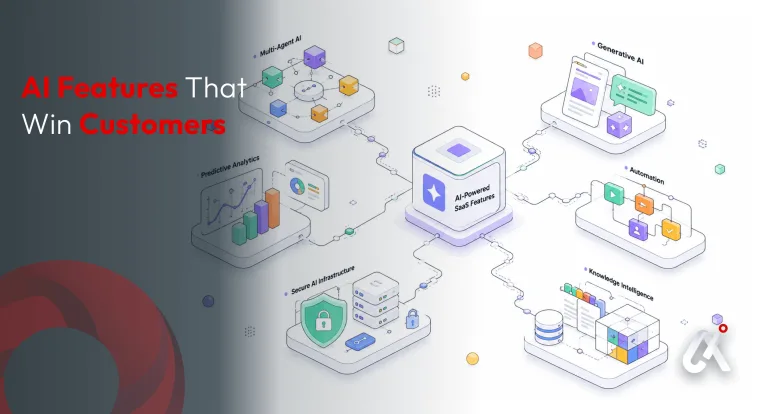
AI SaaS Features That Differentiate Your Product in 2026
The Software-as-a-Service (SaaS) industry in 2026 has crossed a critical threshold
-
Generative AI App Development: Transforming Web and Mobile in 2026
For forward-thinking CTOs, product managers, and enterprise decision-makers, staying competitive requires shifting away from legacy static architectures
-
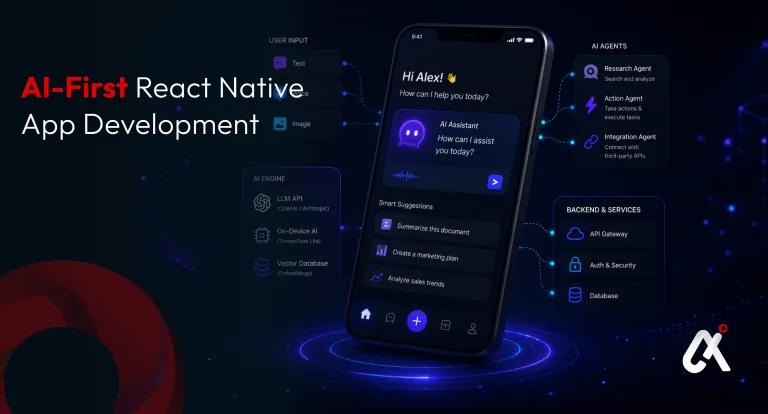
React Native AI: Building an AI-First Mobile App in 2026
A practical guide to AI-powered churn prediction, retention automation, and personalization for two-sided marketplace platforms