

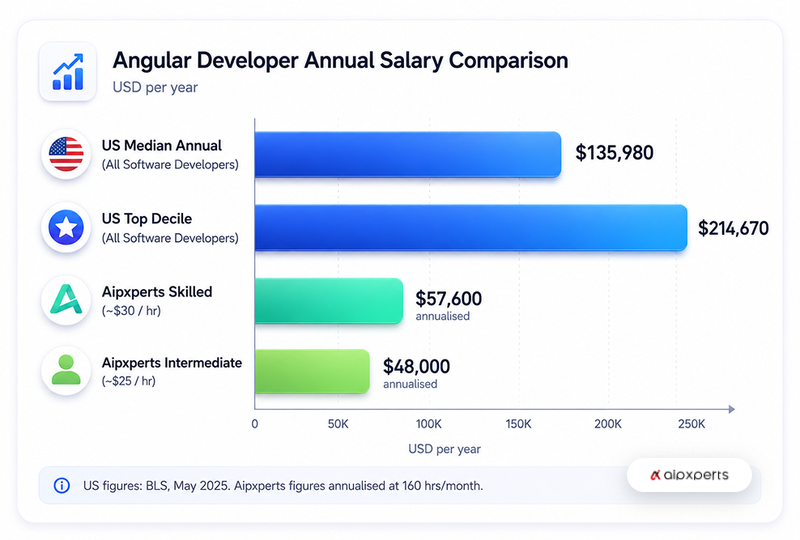
Offshore Angular engineers start at $20 an hour. The US Bureau of Labor Statistics puts the median software developer salary at $135,980 as of May 2025, with the top decile above $214,670. That gap is the whole reason this page gets searched.
What the gap does not tell you is which of those two numbers you should actually be paying. That depends almost entirely on whether the work is a bounded piece of front-end delivery or the long-term ownership of an application your business runs on.
At Aipxperts we place Angular engineers into both kinds of team, and the two conversations look nothing alike. Here is what the money buys, how to tell a real Angular engineer from a React developer who has read the docs, where to look, and how long it honestly takes.
1. What Angular Developers Cost in 2026
Two numbers matter and they are not the same number.
The first is the US benchmark. BLS reported a median annual wage of $135,980 for software developers in May 2025. The bottom 10% earned under $82,460, the top 10% over $214,670. BLS does not break this down by framework, and you should be sceptical of anyone who quotes you an Angular-specific US salary to the dollar. The aggregator sites disagree with each other by $30,000 or more on the same role in the same year, which tells you something about their sample sizes rather than about the market. Add roughly 25% to 35% on top of base for a US W-2 hire once you include payroll tax, benefits and the recruiting fee.
The second is what an agency actually charges. At Aipxperts, Angular sits in our front-end band on the same rates as React, Vue and TypeScript work:
| Level | Hourly | Weekly (40 hrs) | Monthly (160 hrs) |
|---|---|---|---|
| Beginner | $20 | $800 | $3,200 |
| Intermediate | $25 | $1,000 | $4,000 |
| Skilled | $30 | $1,200 | $4,800 |
Rates in USD. Monthly assumes 160 hours. Complex or compliance-heavy work is quoted separately.
A skilled Angular engineer at $30 an hour comes to roughly $57,600 a year at full utilisation. Against a $135,980 US median that reads as a 58% saving, and in a straight staff-augmentation arrangement it broadly is, because you are not carrying benefits, payroll tax or a recruiter’s 20%.
Where the saving evaporates is on projects that need constant product-level decision-making in your timezone. If someone has to be in your stand-up, your Slack and your customer calls, an eight-hour offset costs you more in round-trips than it saves in rate. We turn that work down more often than you would expect.
2. Angular or AngularJS? This One Still Costs People a Hiring Round
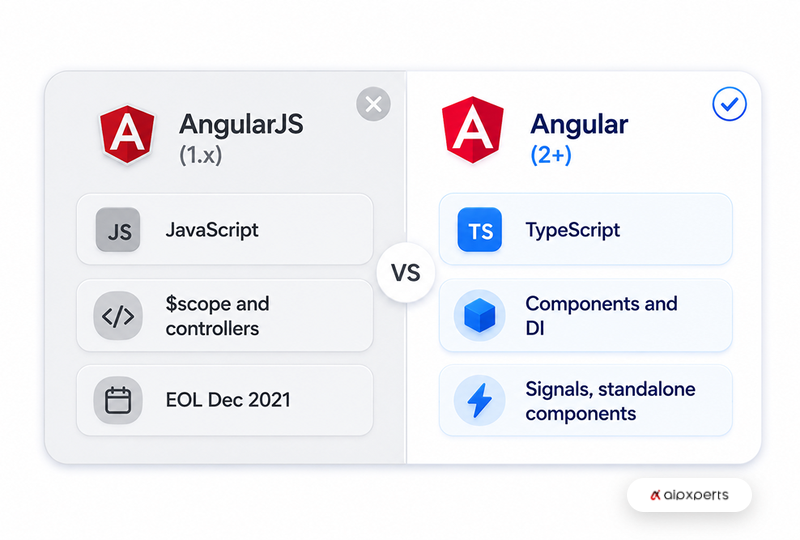
AngularJS version 1.x reached end of life in December 2021. Angular version 2 and everything after is a different framework that happens to share a name.
Candidates with “8 years of Angular” on a CV sometimes mean six years of AngularJS and two of Angular. The interview goes fine, because the vocabulary overlaps. The problem surfaces in week three, when they are writing controller-and-scope patterns inside a standalone component architecture.
Ask directly: which version did you last ship to production, and what changed for you between the version before it and that one. Someone current will have an opinion about Signals. Someone who stopped at AngularJS will describe $scope, the old way of passing data into a template, which modern Angular does not use.
If you are still on AngularJS and looking at a migration rather than a new build, that is a different hire with a different skill profile. Our Angular development guide covers the version history and migration paths in detail.
3. What to Screen for in 2026
Three things are non-negotiable, and they are not the three most CVs lead with.
Start with TypeScript depth rather than TypeScript familiarity. Angular is TypeScript-first in a way React is not, and a developer who reaches for any when the type gets awkward will produce a codebase that compiles and lies to you. Ask them to talk through a generic they have written. Across our TypeScript work this single signal has predicted more than years of experience does. If the JavaScript versus TypeScript question is still open on your side, settle that before you start interviewing.
Then RxJS, under pressure rather than in the abstract. Every Angular application of any size is an RxJS application. “Do you know RxJS” is a wasted question because everyone says yes. The useful version is in the interview section below.
Third, change detection. Zoneless change detection and Signals landed properly in recent versions and they change how you reason about performance. If a candidate explains performance only through NgZone and ChangeDetectionStrategy.OnPush, which are the older Angular controls for deciding when the screen redraws, they are describing 2022 rather than how the framework works now.
Worth having but not disqualifying: SSR experience, Nx monorepo familiarity, and testing beyond the default Karma setup.
4. Four Questions That Actually Separate People
Skip the trivia. These four have a right answer and a revealing wrong one.
- “A component re-renders on every keystroke in an unrelated form field. Walk me through how you would find out why.” You are listening for a diagnostic sequence, not a fix. Anyone who names the tool before the symptom is guessing.
- “
switchMapormergeMapfor a typeahead search, and what breaks if you pick the other one?” These are two RxJS operators that decide what happens when a new request arrives before the previous one has finished. The answer isswitchMap, because it cancels the older request, whilemergeMaplets both finish and you end up showing whichever returns last, which is often the stale one. Developers who have only read about RxJS know the operators. Developers who have shipped with it know which bug this causes. - “Where would you put state that three sibling components need, and when would you not reach for a state library at all?” Good answers include “not everywhere” and mention the cost of the abstraction.
- “A stakeholder wants a feature that will take three weeks and you think it should take one. What do you do?” Nothing to do with Angular. It is the question that tells you whether you are hiring an engineer or a ticket-closer.
5. Where to Find Angular Developers
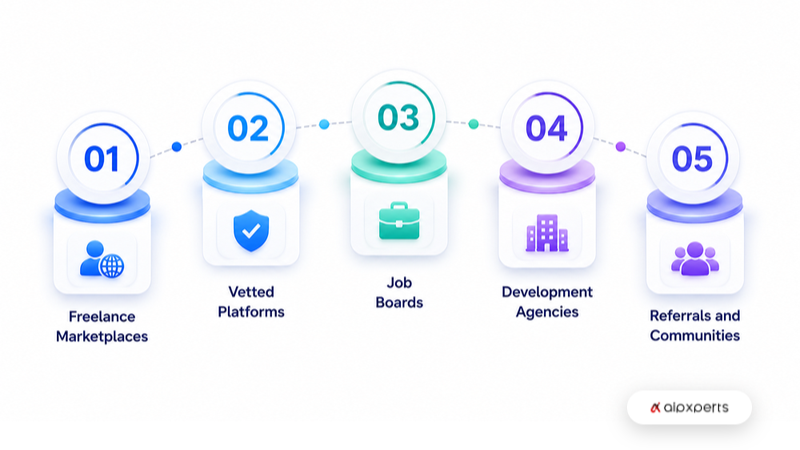
Five channels, and they are not interchangeable. What you pick should follow from how long the work lasts and who is directing it.
| Channel | Typical rate | Best for | Watch out for |
|---|---|---|---|
| Freelance marketplaces | $25–$80/hr | Short bounded tasks | Availability changes without notice; no bench cover |
| Vetted talent platforms | $60–$150/hr | Fast senior placement | The vetting premium is most of what you pay |
| Job boards, direct hire | Salary + 20% fee | Permanent ownership | 8–14 weeks elapsed, counter-offers |
| Development agencies | $20–$60/hr | Ongoing team capacity | Ask who exactly is assigned, not who was in the pitch |
| Referrals and communities | Varies | Hard-to-find specialisms | Slow, and it does not scale past a couple of hires |
Angular-specific communities are worth knowing about: the official Angular Discord, the ng-conf and AngularConnect speaker lists, and the contributor graphs on the larger Angular open-source libraries. A developer who has landed a merged pull request in the Angular ecosystem has been through a review process stricter than most interviews.
6. How to Evaluate an Angular Portfolio
Most portfolio reviews look at screenshots. Screenshots tell you a designer was involved. Ask for something you can open instead: a code sample, or a public repository.
Then look for four specific things. Search the sample for subscribe( and check whether each one is paired with a cleanup mechanism, usually takeUntilDestroyed, an async pipe, or an explicit teardown. A subscription that is opened and never closed keeps consuming memory after the user has left the screen, and this is the most common source of production memory leaks in Angular applications. Check where the business logic lives, since rules sitting inside components rather than services is the clearest sign of someone who has not maintained an application past its first year. Open the test files and see whether they assert behaviour or merely check that the component renders. And if you can see the commit history, read it. Twenty commits called “fix” tells you as much as the code does.
Two questions are worth asking about any project they show you: what would you do differently now, and which part of this did you not build. Candidates who cannot answer the second one honestly are usually presenting team work as solo work.
7. Red Flags
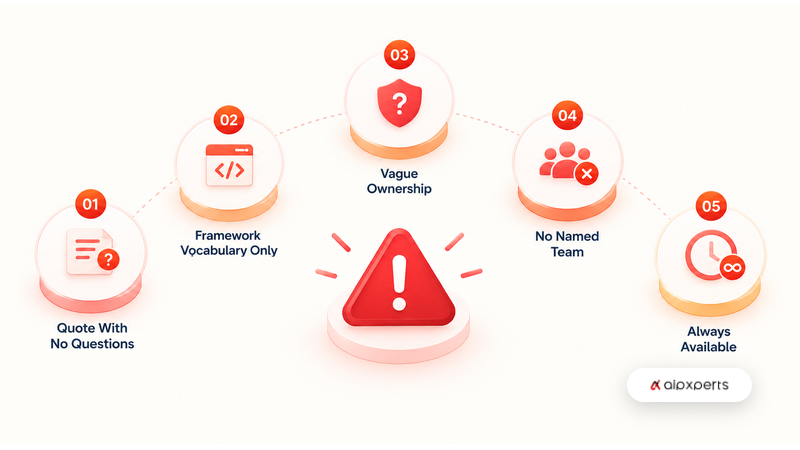
- A quote arrives before any questions are asked. Nobody can price Angular work without knowing the state of your existing codebase. A number that comes back same-day with no discovery is a number that will change.
- Framework vocabulary with no product opinions. A developer who can define every Angular concept but has no view on when Angular is the wrong choice has learned the documentation rather than the job.
- No named individual. “We will assign a senior resource” is not an answer. Ask for the name, the CV, and a conversation with the person who will actually write the code. If the person in the sales call is not the person who codes, that gap is where most disappointment comes from.
- Availability that never changes. A supplier whose best engineers are always free right now either has a bench problem or is not telling you who you are getting.
Vague answers on code ownership belong on this list too, which brings us to the part everyone skips.
8. Contract, IP and Code Ownership
Four clauses to settle in writing before work starts.
Intellectual property comes first. The agreement should say that all code, designs and documentation transfer to you on payment, and that the transfer covers derivative work. Watch for language that assigns “deliverables” but stays silent on intermediate work, build tooling and configuration.
Ask which third-party and open-source licences the developer intends to use. An AGPL dependency inside a commercial product is a problem you want to find at contract stage rather than during due diligence two years later.
Tie payment to milestones you can look at, not to time elapsed. “Sprint 3 complete” is not a milestone. “Authentication flow deployed to staging and passing the agreed test cases” is.
Finally, exit terms: what happens to work in progress, credentials, repository access and documentation if either side ends the arrangement. On a staff augmentation arrangement, agree the notice period per engineer rather than for the contract as a whole.
9. How Long This Actually Takes
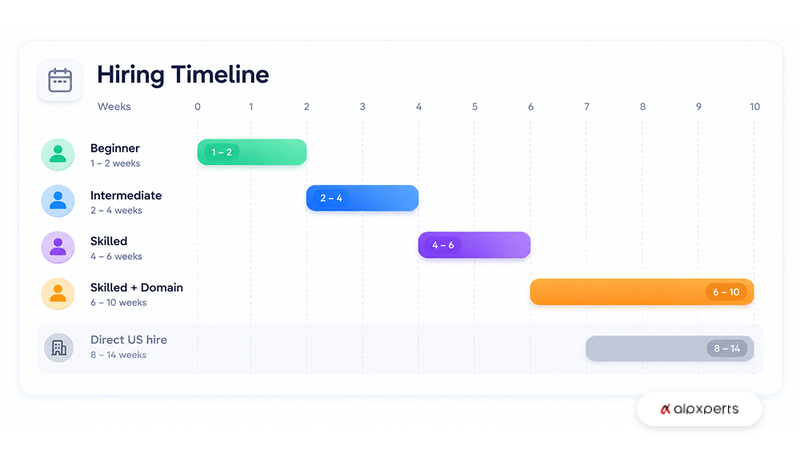
Realistic elapsed time from open requisition to first commit, based on Aipxperts placements:
| Level | Time to place | Why |
|---|---|---|
| Beginner (0–2 yrs) | 1–2 weeks | Deep pool, short screen |
| Intermediate (3–5 yrs) | 2–4 weeks | Most in-demand band |
| Skilled (5+ yrs) | 4–6 weeks | Thin pool, usually employed |
| Skilled + domain (fintech, health) | 6–10 weeks | Compliance experience narrows it further |
Direct US hiring runs longer than all of these, mostly because notice periods and counter-offers add weeks that no process improvement removes.
10. Engagement Models Compared
This is the decision most people get wrong, and almost nobody publishes a straight comparison of it. So here is one.
| Staff augmentation | Dedicated team | Fixed-scope project | |
|---|---|---|---|
| Who manages the work | Your manager | Our delivery lead | Our delivery lead |
| Best when | You know what to build, you are short on hands | Ongoing product ownership | Scope genuinely will not move |
| Ramp-up | 1–2 weeks | 2–4 weeks | 2–3 weeks incl. discovery |
| Cost model | Hourly, per engineer | Monthly, per team | Fixed price |
| You can change scope | Any time | Sprint boundary | Change request only |
| You need to supply | Backlog, code review, direction | Product priorities | A locked specification |
| Fails when | Nobody on your side has capacity to direct | You want to micro-manage | Requirements are still moving |
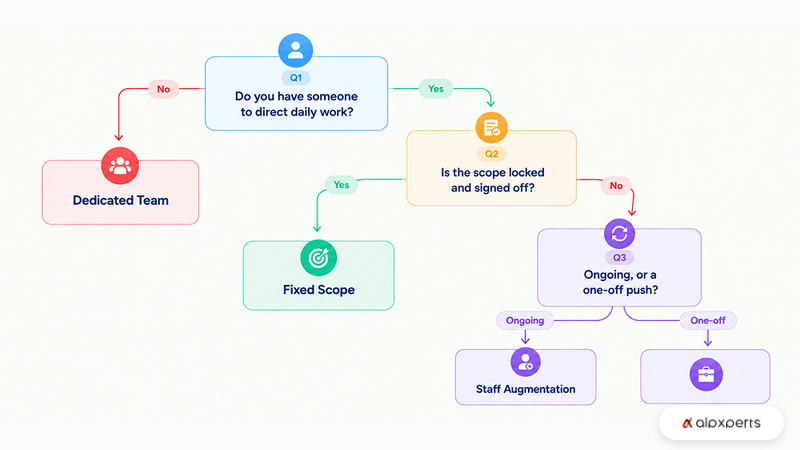
Most Angular engineers Aipxperts places go out as staff augmentation, because front-end work usually sits inside a team that already exists. A dedicated development team makes sense when you are handing over a product surface entirely and have nobody internally to direct daily work.
Fixed-scope is the one to be careful with. It is the cheapest model on paper and the most expensive one when the specification turns out to be a wish rather than a decision. If the commercial structure matters more to you right now than the technology does, our IT outsourcing page sets out how each of these models is contracted.
11. Mistakes We Keep Seeing
- Hiring a React developer and hoping. They are both component frameworks, so it looks like a short jump. It is not. Dependency injection, decorators, modules and RxJS are four separate mental models and the crossover takes two to four months. If you want React, hire React developers and stop calling the role Angular.
- Interviewing for the framework and forgetting the browser. We have watched strong Angular candidates ship components that pass every unit test and fall over on a mid-range Android phone. Ask something about bundle size.
- Buying seniority you have no work for. A skilled engineer building forms and list views will be bored in six weeks and gone in twelve. Two intermediates and clear code review beats one senior with nothing to architect, and it costs less.
- Underestimating the review load. Staff augmentation means someone on your side reviews the code. If nobody has three hours a week for that, you do not want augmentation, you want a team that reviews its own work.
On a logistics platform Aipxperts rebuilt last year, the single largest performance gain came from removing unsubscribed observables that had accumulated over three years of feature work. No new features. Just leaks. That is the kind of thing the RxJS question above is designed to find before you hire, rather than after. Clients describe that work in their own words in our customer success stories.
12. Working with Aipxperts on Angular
We have been building front-end applications since well before Signals existed, and Angular work at Aipxperts sits inside our wider web application development practice rather than in a separate silo. Practically, that means three things for you.
You get named engineers, with CVs and a call before anyone signs. You are told which version of Angular they last shipped and what they worked on. And the rates above are the rates: $20, $25 and $30 an hour by level, not a starting position that moves once you are committed.
The honest counterpart is that we are not the right choice for everything. If your Angular work needs someone sitting in your product meetings making commercial trade-offs live, an offshore engagement will frustrate you regardless of who supplies it. If you have nobody internally with three hours a week for code review, augmentation is the wrong model and we will say so before you sign rather than after. And if what you actually need is a full application built from nothing, that is a dedicated team conversation, not an hourly one.
13. Frequently Asked Questions
How much does it cost to hire Angular developers?
Aipxperts rates run $20 an hour for beginner, $25 for intermediate and $30 for skilled, which works out at $3,200 to $4,800 a month at 160 hours. A US in-house hire is a different calculation: the BLS median for software developers was $135,980 in May 2025, and you should add 25% to 35% for payroll tax, benefits and recruiting.
Is Angular still worth building on in 2026?
For large applications in regulated industries, yes. Its structure is an advantage when eight people are in the same codebase and a constraint when two people are racing to a launch. We cover that trade-off properly in our Angular development guide.
Can a React developer work on our Angular project?
Eventually. Budget two to four months before they are shipping at full speed, and do not put them on architecture decisions in that window.
How quickly can you place an Angular developer?
One to two weeks at beginner level, two to four at intermediate, four to six for skilled engineers. Domain-specific requirements such as HIPAA or PCI experience push it to six to ten.
Who owns the code when I hire Angular developers offshore?
You do, provided the contract says so explicitly and covers derivative work as well as final deliverables. Settle it before work starts. The contract section above lists the four clauses that matter.
Do we need a full-stack developer or a front-end specialist?
If your API is stable and owned by another team, hire the specialist. If the same person needs to move between the UI and the service layer, you are looking for a full-stack generalist rather than an Angular hire, and the screening changes accordingly. Our comparison of MEAN, MERN and full stack is a sensible starting point for working out which shape of engineer you actually need.
What if we picked the wrong framework?
It happens more than people admit. If you are early enough that the decision is still reversible, weigh the front-end options before committing, and note that Vue suits smaller teams that Angular’s structure would slow down.
Need Angular engineers inside your existing team? Tell Aipxperts what you are building and who will be directing the work, and we will tell you honestly whether augmentation or a dedicated team fits. Get in touch.