AI Chatbot Development Services Built Around What the Bot Should Refuse to Answer
Any model can produce a confident sentence. The engineering that matters is making it answer from your content, admit when it cannot, and hand a person a conversation they do not have to restart. Our AI chatbot development services are measured on those three before anything else.
Get a Containment Review 5.0
5.0 5.0
5.0 4.3
4.3 4.8
4.8Where a Chatbot Build Actually Starts
Not with the model, and not with the interface. With the questions people are already asking and what your organisation currently does with them.
Every chatbot project has a real starting document and it is usually a support inbox or a call log. What people actually ask, in their own words, with the volume attached. From that you can tell which questions have a stable answer that lives somewhere in writing, which need a human because they involve judgement or money, and which nobody should be answering automatically at all.
That split is the design. A bot pointed at the first group is useful within weeks. A bot pointed at all three is the one that gets switched off after a quarter, because the failures are visible to customers and the successes are not. So we scope the first group deliberately narrowly and expand it against evidence rather than ambition.
If it needs to take actions rather than answer questions · If the shape of the AI work is not settled yet
Our Chatbot Development Team, in Numbers
The team and delivery record behind the conversational work on this page.
60+
AI Engineers
50+
AI Solutions Delivered
80+
AI-Integrated Workflows
30+
Industries Served
95%
Client Retention
Our AI Chatbot Development Services, End to End
Each service below can run on its own or as part of one engagement. Transcript analysis and conversational design are where the value is won or lost, and they are the two clients most often want to compress.
AI Chatbot Consulting and Scope Definition
We read what your customers already ask, cluster it by volume, and agree with you which clusters the bot should handle, which need a person, and which should be fixed in your product instead of answered. You get a scope drawn from real transcripts rather than from a workshop, which is the commonest cause of a failed chatbot.
Conversational AI Design
We write how the bot opens, how it asks for clarification, how it refuses and how it ends, before any model is chosen, because these are product decisions rather than technical ones. Refusal and clarification are where a bot earns or loses trust, and both are usually left unwritten.
RAG and Knowledge Base Grounding
We connect the bot to your own content so answers come from your documents rather than from a model’s general knowledge, with citations attached to what it says. Where retrieval itself turns out to be the hard part, it becomes RAG development.
Custom Chatbot Development
We build the interface, the conversation flow, the grounding, the guardrails and the evaluation harness that runs against every change. The evaluation set is handed over with the build, so your team can tell whether a change improved anything without calling us.
Chatbot Integration With Your Existing Systems
We connect the bot to your helpdesk, CRM, order system or knowledge base so a conversation can be continued rather than logged and lost. This is what decides whether a handoff carries context; without it the customer repeats everything and the bot has cost you goodwill.
Chatbot Support and Content Maintenance
We run the evaluation suite as your content and your model provider change, report what moved, and keep the answer content current. A bot grounded in content that has drifted is worse than no bot, and the drift is silent.
AI Chatbot Projects We Have Delivered, and What Each Was Allowed to Answer
Each card names the scope boundary we agreed: what the bot handled, and what it deliberately passed to a person. That single line is the design decision everything else follows from, and the figures sit on the case study itself.
Education
Classroom Walkthrough Software Used by School Leaders Across 10+ Countries
Instructional coaching only works if the loop closes while the lesson is still fresh. Seven years of building later, school leaders across more than ten countries return structured feedback the same day.
Read case study: Classroom Walkthrough Software Used by School Leaders Across 10+ CountriesMarketplace
Building the AI Layer Behind a Live Marketplace Without Touching Checkout
The marketplace was already live and taking payments, which ruled out rebuilding it. The AI layer runs as a separate FastAPI service, so models can change without redeploying the code that handles checkout.
Read case study: Building the AI Layer Behind a Live Marketplace Without Touching CheckoutWhat Clients Said After Go-Live
In their own words, on platforms that verify an engagement before publishing a review.

We have contracted a developer from Aipxperts now for several months, based on a referral. We have been very pleased with the quality of the work, the knowledge and skill level of our developer, and the value we're receiving for our fee. We also very much appreciate that the development team works at night (effectively), so we are sometimes able to turn client requests around in a day.There have been a couple of situations where we needed urgent help outside of our developer's normal business hours, and we've received that help (for which I am very grateful). While we have some challenges with communication sometimes, our overall satisfaction level is very high.

Our experience working with Aipxperts has been exceptionally satisfying. From start to finish, they handled the project with professionalism and responsibility. Communication was seamless, and they effectively addressed our requirements, delivering high-quality results on time. Their technical expertise was particularly impressive, as they effortlessly solved complex problems. We highly recommend Aipxperts for their outstanding service and dedication to client satisfaction.
Chatbot Scope by Industry, and What Must Reach a Person
Each entry names the conversational work we most often deliver in that industry, and the kind of question that has to reach a person regardless of how well the model performs.
eCommerce
Order status, returns policy and stock questions automate well and carry most of the volume on an eCommerce site. Anything touching a refund amount or a payment dispute goes to a person, because a wrong number in writing becomes a commitment.
Logistics and warehousing
Live consignment state where the useful answer changes hour to hour and comes from a carrier rather than from your own system. In logistics and warehousing the bot has to read current state rather than documentation, which makes integration the whole build.
On-demand platforms
High volume, short conversations and a strong penalty for latency. On on-demand platforms anything involving a safety report or a dispute between two users is escalated immediately and without negotiation.
Telecom
Account, billing and provisioning questions where the answer depends on a customer’s specific plan. Grounding in general documentation produces confident wrong answers in telecom more than in any other sector.
Education and EdTech
Enrolment and course questions that spike hard at term boundaries, with a user base that may include children. In education and EdTech, consent and content standards constrain what may be logged as much as what may be said.
Health and fitness
Programme, billing and app questions automate fine. Anything a health and fitness user could reasonably read as advice does not, and the refusal has to be designed rather than left to a system prompt.
Automotive and dealer networks
Service booking, parts availability and warranty questions, where the answer depends on which dealer the customer belongs to. Across automotive and dealer networks, identifying that correctly is the part that quietly breaks these builds.
The Practices Behind a Chatbot That Survives Contact With Customers
Practices behind a chatbot that survives real customers, including one that limits what Aipxperts will claim.
01Answers are grounded in your content, with citations attachedThe bot answers from your documentation, your policies and your systems rather than from a model’s general knowledge, and it shows where each answer came from. A citation is also the fastest way for your team to spot that a source document is out of date.
02A model-agnostic architecture, because providers changeThe model sits behind an interface rather than through the codebase. Providers change pricing, deprecate versions and shift behaviour, and a build wired directly to one of them turns every such change into a project.
03Evaluation sets built before the bot goes liveA fixed set of real questions with agreed correct answers, run against every change. Without it, nobody can tell whether an improvement improved anything, and teams end up tuning by anecdote.
04Handoff engineered as a first-class pathThe escalation route is designed with the same care as the answering route: full conversation context, the customer’s identity where known, and no repetition. Treating handoff as a failure state is why so many bots are hated.
05The limit of what this team will claimWe will not promise a deflection percentage before seeing your transcripts, and we will not present a demo as evidence of production behaviour. Anybody quoting a containment figure in a first meeting is quoting somebody else’s project.
The Numbers to Demand From Any Chatbot Vendor
Chatbot projects are unusually easy to make look successful and unusually hard to evaluate. The measures below resist that, and abandonment is the one nobody volunteers.
Containment, and what it excludesThe share of conversations resolved without a person. Useful only if abandoned conversations are excluded, because a customer who gives up looks identical to a customer who was helped. Ask any vendor how their containment figure treats abandonment and the answer tells you a great deal.Grounded accuracy on a fixed question setRun the same set of real questions, with agreed correct answers, before and after every change. This is the number that stops improvement being a matter of opinion, and it is why the evaluation suite is built before launch rather than after.Refusal correctnessTwo failures hide here and they pull in opposite directions. A bot that answers something it should have escalated is dangerous. A bot that escalates everything is expensive and pointless. Both are measurable against the same question set and almost nobody measures them.Handoff quality, measured on the human sideWhether the person receiving the conversation had to ask anything the customer had already answered. This is the only one of the four that has to be measured by asking your own staff, which is exactly why it gets skipped.And the number worth more than any of themThe change in questions arriving at all. A well-scoped chatbot programme often reveals that the largest cluster of questions exists because something in your product is unclear. Fixing that removes the question rather than answering it faster, and no bot metric will ever show it.
What the Conversational Layer Is Built With
The model providers, retrieval, orchestration and evaluation tooling our engineers work across. The architecture keeps the model behind an interface deliberately, so what is listed here can change without the build changing.
Language models
 OpenAI
 Anthropic
 Google Gemini
 Meta Llama
 Mistral AI
 Hugging FaceCohere
Retrieval and vector stores
PineconeWeaviate Qdrant
 MilvusChroma
 PostgreSQL
 Elasticsearch
 OpenSearch
 Redis
Redis
Orchestration and tooling
 LangChainLlamaIndex
 LangGraph
 CrewAISemantic Kernel
 FastAPI
 Python
 TypeScript
Language understanding and embeddings
Hugging Face PyTorch
 TensorFlow
 spaCyNLTK
 scikit-learn
Chatbot platforms
 Rasa
Rasa Google Dialogflow
 Amazon Lex
 Microsoft Copilot StudioIBM WatsonBotpress
Channels and business systems
 WhatsApp
 Slack
Slack Microsoft Teams
 Telegram
 Twilio
 Salesforce
 HubSpot
 ZendeskFreshdesk
 Microsoft Dynamics 365
 Shopify
Deployment, evaluation and monitoring
 Docker
 KubernetesAmazon Web Services
 Microsoft AzureGoogle CloudLangSmith
 Grafana
 Prometheus
 Sentry
Ratings You Can Check Yourself
Verified on Clutch, GoodFirms, Upwork and Google, across web, mobile and enterprise delivery since 2012.
What Leaves Your Environment, and What Does Not
The first question a security reviewer asks about a chatbot is where the data goes, and it deserves an answer before the first prototype rather than at the review. All of it is settled at architecture stage, because retrofitting any of it costs several times what designing it in does.
What is sent to a model provider, and what is notOnly what the conversation requires, with personal data minimised or redacted before it leaves your environment where the design permits. Which fields those are gets agreed in writing at design stage rather than discovered during a security review.Training, and the first thing a security reviewer asksYour conversations do not go into anybody’s training set. Where a provider’s terms permit that by default, the configuration disabling it is applied and the evidence handed over rather than asserted.What the models are, and what they are notCommercially available models accessed through their providers, configured and grounded rather than trained from scratch. Nobody here is building a foundation model and no page on this site should be read as claiming otherwise.Logging, retention and who can read itConversation logs live in your environment on a retention period you set. Access is named and revocable. Where transcripts are used for evaluation, they are the redacted set rather than the raw one.The certificate question, answered firstNeither ISO 27001 nor SOC 2 is held here, and no partner status exists with any model provider. What can be inspected during the build is the data-handling design itself, which is documented per engagement.
Our Chatbot Development Process, and What Each Stage Measures
Every stage we run produces a measurement rather than a milestone. That is the difference between a chatbot that demos well and one that performs, and it is why we will not show you a prototype before the evaluation set exists.
01Transcript analysis and scopeReal questions clustered by volume and by whether a stable written answer exists. The first measurement is how much of your volume sits in the answerable cluster, which is the honest ceiling on any containment figure.02Refusal and escalation designWhat the bot must never attempt, and what happens the moment it hits one of those. We measure whether your own team agrees on the refusal list. They usually do not, and that disagreement is worth surfacing now.03Content readiness assessmentWhether the documents the bot will answer from are current, consistent and specific enough to answer with. What surfaces first is contradictions between sources: every organisation has them, and a bot finds them faster than any audit.04Evaluation set constructionA fixed set of real questions with agreed correct answers, including questions the bot should refuse. Nothing is measured yet; this stage exists so every later one has something to be measured against.05Build and grounded prototypeRetrieval, guardrails, conversation flow and citations, evaluated against that set rather than demonstrated. Grounded accuracy and refusal correctness are measured together, because improving one usually degrades the other.06Integration and handoffConnection to the systems that let a conversation continue, and the escalation path carrying full context. The measure that counts is whether the receiving agent had to ask anything the customer already answered.07Limited release and expansionLive to a fraction of traffic, expanded against evidence rather than against a plan. Abandonment is what we watch, because it is the failure that containment figures conceal.
Points to Settle Before Commissioning a Chatbot
One of these answers is the one most vendors avoid giving, and another argues for not building a bot at all.
Share your project vision
Tell us what you want to build. A specialist, not a salesperson, replies.
Send Us a Week of Transcripts Instead of a Requirements Document
A support export tells us more in an hour than a workshop does in a day. Back comes how much of your volume has a stable answer, which clusters should never be automated, and whether the largest one is a product problem rather than a support problem.
Send a Week of TranscriptsWritten From Live Conversations
Scope decisions, refusal design and evaluation results from bots our engineers put in front of real customers.
-
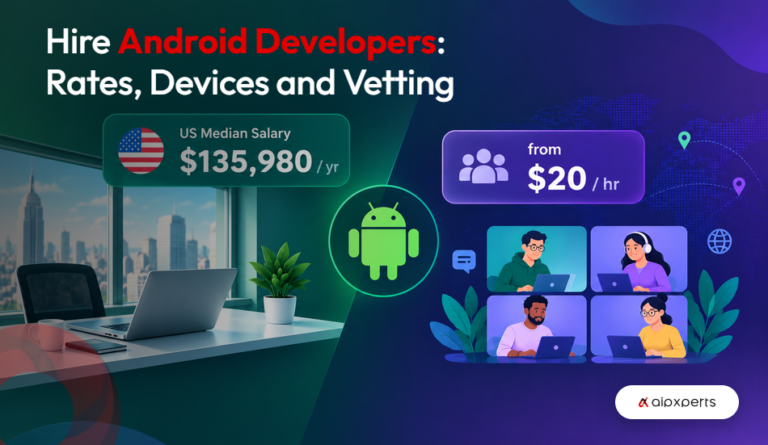
Hire Android Developers: Start From the Device List, Not the CV
Android is the only major platform where your code has to survive hardware the person who wrote it has never touched. An…
-
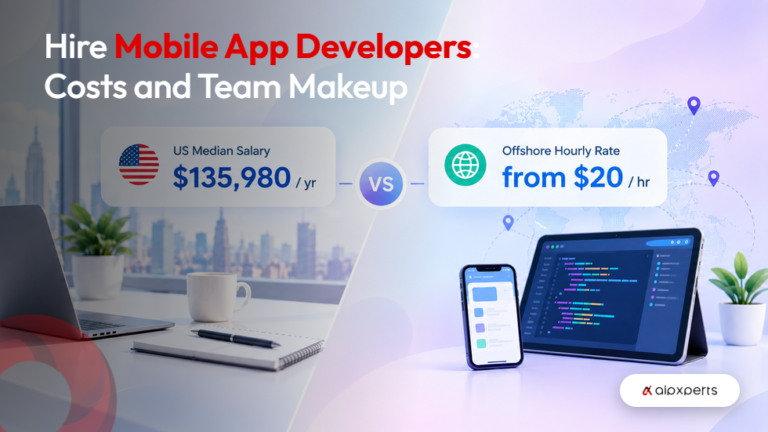
Hire Mobile App Developers: A Five-Step Guide to Getting the Team Right
The most expensive mistake in app hiring is not the rate you agree. It is the headcount you forget. An app is…
-
Hire Flutter Developers: The Risks Worth Screening For
Two Flutter developers can charge the same rate, show you portfolios that look equally good, and leave you with codebases that differ…