
Two Flutter developers can charge the same rate, show you portfolios that look equally good, and leave you with codebases that differ by a year of maintenance work.
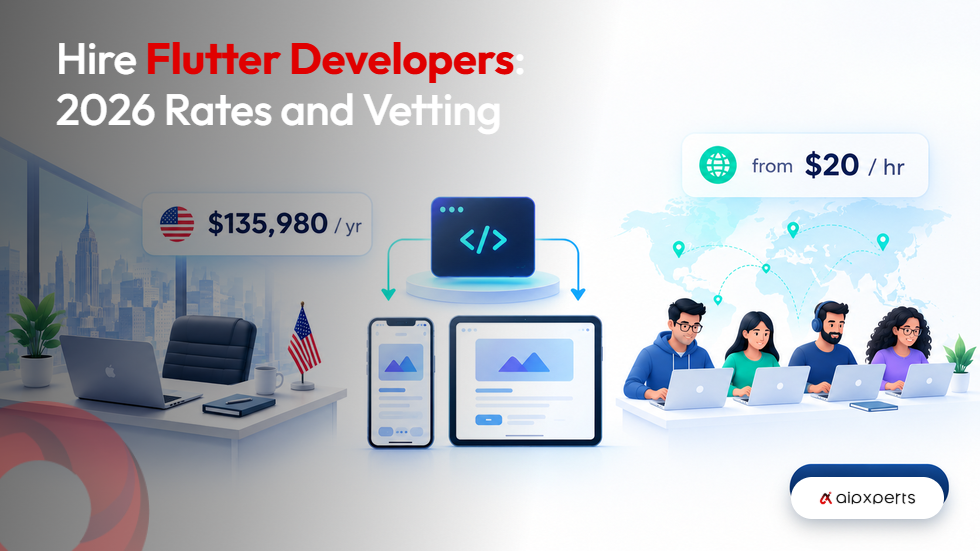
That is the defining feature of this hire. Flutter is genuinely easy to start with, so the distance between a developer who can build a working screen and one who can ship an app you will still want in two years is wider here than almost anywhere else, and none of it shows up in a portfolio. Both produce apps that look right. Rates start at $20 an hour offshore against a US software developer median of $135,980, and the rate tells you nothing about which of the two you are getting.
At Aipxperts we hire Flutter developers onto both new builds and rescue work. Here is what the rates are, the one question that separates the two groups, and the dependency risk nobody warns you about.
1. What Flutter Developers Cost in 2026
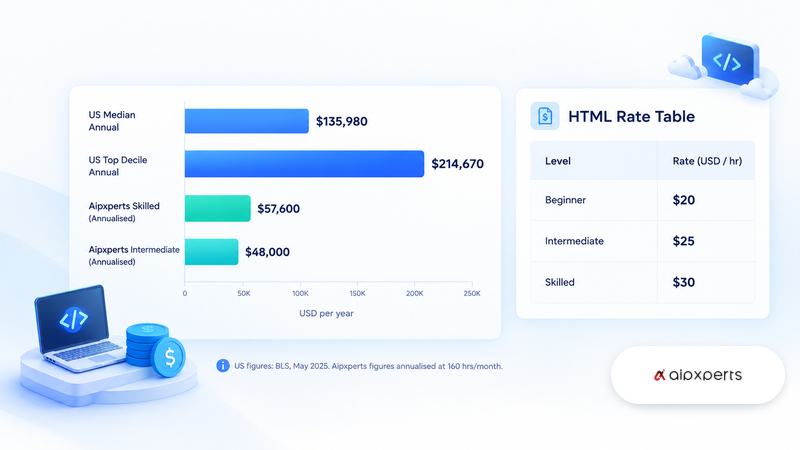
The one public figure worth quoting is from the Bureau of Labor Statistics: $135,980 median annual wage for software developers in May 2025, from under $82,460 at the tenth percentile to over $214,670 at the ninetieth. No framework breakdown exists, and the framework-specific numbers circulating elsewhere come from aggregators sitting $30,000 apart on identical roles. Add a further 25% to 35% for a US W-2 hire once payroll tax, benefits and recruiting are included.
Flutter sits in our development band at Aipxperts:
| Level | Hourly | Weekly (40 hrs) | Monthly (160 hrs) |
|---|---|---|---|
| Beginner | $20 | $800 | $3,200 |
| Intermediate | $25 | $1,000 | $4,000 |
| Skilled | $30 | $1,200 | $4,800 |
Rates in USD. Monthly assumes 160 hours. Compliance-heavy work is quoted separately.
The economic case for Flutter is one team instead of two, and it is real, but it is not a halving. Platform-specific work does not disappear. Permissions, notifications, deep links, in-app purchases, store submissions and native integrations still have to be handled twice, because the two platforms genuinely differ. What Flutter removes is writing your interface and business logic twice, which is most of the app but not all of it. Budget for a meaningful minority of the work still being platform-specific and you will not be surprised.
For the project-level cost of building in Flutter rather than the cost per developer, our Flutter development guide has the breakdown.
2. The Plugin Question
This is the most useful thing on this page and no competing guide covers it, so it goes early.
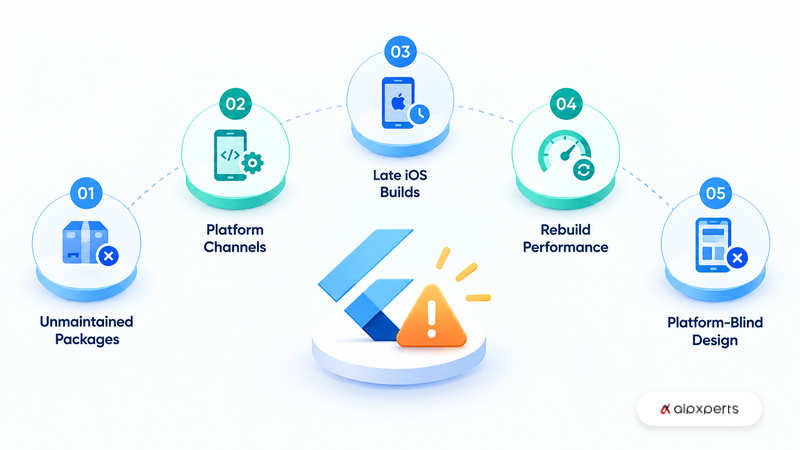
Flutter’s package ecosystem is the reason it is fast to build with. It is also the largest hidden risk in any Flutter codebase, and it is entirely a hiring question rather than a technical one.
A great deal of what an app needs beyond drawing screens comes from community packages: camera access, Bluetooth, secure storage, background location, in-app purchases, push notifications. Some are maintained by Google. Many are maintained by one person who has moved on. When a package stops being updated and the platform underneath it changes, you inherit it. That means someone on your side reading, understanding and maintaining code written by a stranger, inside a dependency you did not plan to own.
So ask any candidate: how do you decide whether to add a package or write it yourself, and have you ever had to fork one?
A developer who has shipped and then maintained an app will have a real answer. They will talk about checking recent commits, open issue counts, whether it wraps a platform API that changes often, and whether the app can survive the package disappearing. Someone who has only built will say they check the pub.dev score, which is a popularity signal and not a maintenance guarantee.
The forking question is the sharper half. Anyone who has run one of these apps for more than a year has forked or replaced a dependency, or has been lucky.
3. Beyond Packages: Three More Things to Check
Three things beyond the plugin question.
State management, and specifically an opinion about it. Flutter deliberately does not impose one, so every team picks. What matters is not which one they use but whether they can explain the trade-off and what happens when the app grows past the point their choice was comfortable with. A developer with no opinion has only worked inside someone else’s decision.
Then platform channels. This is the boundary where Dart calls native code, and it is where cross-platform stops being free. A developer who has never written or debugged one has never hit the edge of the framework, which means they have not built anything that touches hardware or a platform-specific service.
Third, rendering and rebuild cost. Flutter makes it very easy to rebuild far more of the interface than necessary, and the result is an app that is smooth on a flagship and visibly stuttering on a mid-range Android handset. Ask how they would find out why a list is janky. You want profiling before guessing.
Worth having but not disqualifying: flutter_test and integration testing beyond widget tests, CI producing signed builds for both stores, and any experience with Flutter on web or desktop if that is on your roadmap.
4. Four Questions That Expose the Gap
- “How do you decide whether to add a package or write it yourself, and have you ever forked one?” Covered above. The best single filter on this list.
- “You need something the framework does not expose, say a specific camera capability. What do you do?” A platform channel, written twice, once per platform. Anyone who says they would look for a package and stops there has not been pushed to the edge yet.
- “A scrolling list stutters on a mid-range Android device but is fine on your phone. Walk me through it.” Profile it on the device that stutters, look at what is rebuilding and what work is happening during the frame. Guessing at causes before profiling is guessing.
- “Your app needs to keep working with no connection for an hour. What changes in your architecture?” Local storage as the source of truth with sync on reconnect, rather than the network as the source of truth with a cache bolted on. This one separates developers who have shipped to real users from developers who have shipped to a demo.
5. Where Flutter Developers Get Caught Out
Three places, consistently, and they are worth knowing before you interview rather than after.
The last 20% of platform work. Everything above is a version of this. Screens and logic come fast, and then permissions, notifications, deep links, purchases and store submission arrive at the end and are platform-specific. Teams that planned only for the shared part discover the timeline was wrong at exactly the wrong moment.
Assuming the iOS build will behave. Developing on Android and testing on iOS late is a common and expensive habit, because Flutter makes the two look identical until they do not. Scrolling physics, permissions, keyboard behaviour and store review all differ. Ask when in a project they first build for iOS. Anyone who says the end has been bitten or will be.
Design that ignores the platform. Flutter renders its own widgets, so an app can look exactly the same on both platforms. Whether it should is a product decision. Users notice when navigation and gestures feel foreign, and a developer who has never had that conversation with a designer has not shipped a consumer app that was held to a standard.
If you are still deciding between Flutter and the alternatives, our cross-platform frameworks comparison is the better starting point, and if the app is the product rather than a means of access, native iOS and Android hiring is a different conversation.
6. Where to Find Flutter Developers
| Channel | Typical rate | Best for | Watch out for |
|---|---|---|---|
| Freelance marketplaces | $25–$70/hr | Short bounded work | Very wide quality spread; Flutter is easy to start |
| Vetted talent platforms | $60–$150/hr | Fast senior placement | The vetting premium is most of what you pay |
| Job boards, direct hire | Salary + 20% fee | Long-term app ownership | 8–14 weeks, counter-offers |
| Development agencies | $20–$60/hr | Ongoing capacity plus device coverage | Ask who is assigned, not who was in the pitch |
| Flutter communities | Varies | Genuine specialists | Slow, does not scale past a couple of hires |
The community route is unusually productive for Flutter. The ecosystem is young enough that the people maintaining significant packages are findable, and a candidate with merged contributions to a widely used package has demonstrated exactly the maintenance instinct the plugin section above is about.
7. Signals That Should Slow You Down
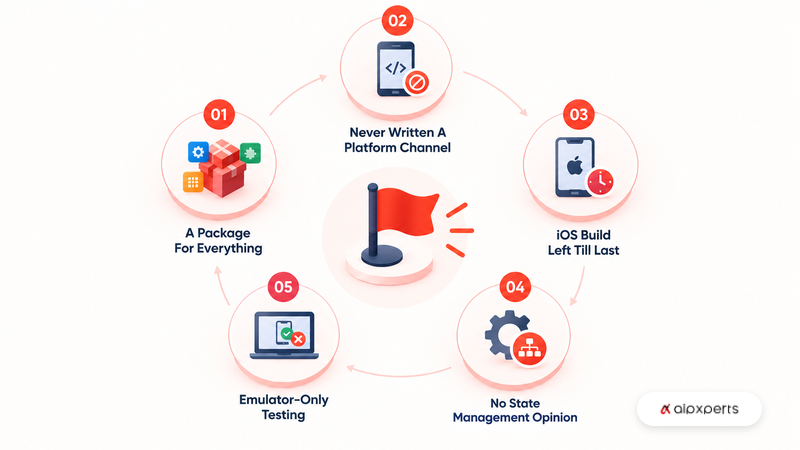
- A package for everything. A candidate whose answer to every capability is a package name has not yet had to maintain one.
- Never written a platform channel. Fine for a simple app. A real gap for anything touching hardware or a platform service.
- Leaving the iOS build until late. Ask directly. The answer predicts whether your timeline holds.
- No opinion on state management. Not a preference, an opinion, with a reason and a trade-off attached.
- Emulator-only testing. Flutter performance problems appear on mid-range physical hardware and nowhere else. Ask what devices they test on.
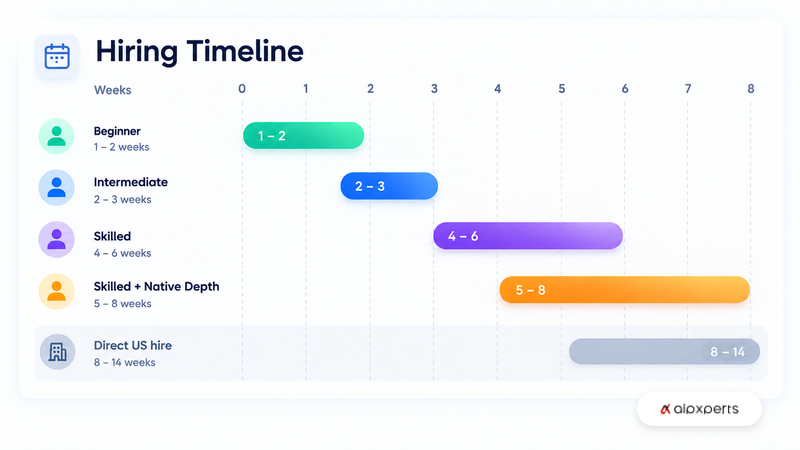
8. How Long a Flutter Hire Takes
| Level | Time to place | Why |
|---|---|---|
| Beginner (0–2 yrs) | 1–2 weeks | Very deep pool, low barrier to entry |
| Intermediate (3–5 yrs) | 2–3 weeks | Healthy supply |
| Skilled (5+ yrs) | 4–6 weeks | Flutter is young, so genuine 5-year experience is scarce |
| Skilled + native platform depth | 5–8 weeks | Flutter plus real iOS or Android knowledge is a rare combination |
That third row deserves a note. Flutter has not been in wide production use long enough for deep experience to be common, so someone claiming eight years should be asked what they were doing for the first three.
9. Engagement Models, and the One Flutter-Specific Risk
| Staff augmentation | Dedicated team | Fixed-scope project | |
|---|---|---|---|
| Who directs the work | Your manager | Our delivery lead | Our delivery lead |
| Suits | An existing Flutter app and a roadmap you own | A new app for both stores | A defined piece: a rebuild, a native-to-Flutter migration |
| Ramp-up | 1–2 weeks | 2–4 weeks | 2–3 weeks incl. discovery |
| Billing | Hourly, per engineer | Monthly, per team | Fixed price |
| Changing scope | Any time | At a sprint boundary | Change request only |
| You must supply | Backlog, code review, device list | Product priorities and a device list | A settled specification |
| Who owns store releases | You | Us, or shared | You, after handover |
| Goes wrong when | Nobody your side reviews code | You want to direct daily work anyway | Package or platform surprises change the scope |
That last cell is specific to this framework. Fixed-scope pricing assumes the work is knowable in advance, and a Flutter project’s dependency surface is exactly the part that is not. If a package you rely on stops being maintained mid-project, someone absorbs that cost. Agree who before you start.
Most Flutter work we place is staff augmentation into an existing app or a dedicated team for a new one. If the app needs design and QA as well as engineering, our wider mobile app development work covers the full team.
10. Where Flutter Projects Go Wrong
- Choosing Flutter to halve the budget. It reduces the work, it does not halve it, and a plan built on halving will be short by the amount of platform-specific work nobody counted.
- Hiring junior because the framework is approachable. The low barrier to entry is real and it cuts both ways. The framework’s forgiving nature means a junior can produce something that looks finished and is expensive to maintain, and you will not find out for months.
- Skipping the dependency audit on inherited code. On a marketplace app Aipxperts picked up mid-life, the first useful thing we did was not writing features. It was going through the dependency list and working out which packages were still maintained, which had been abandoned, and which the app could not survive losing. That audit changed the roadmap before a line was written. That audit, and others like it, show up from the client’s perspective in our customer success stories.
- Testing on emulators and flagship phones. Performance problems live on mid-range Android hardware. Our testing work is scoped around real devices for that reason.
11. How Aipxperts Places Flutter Engineers
Flutter sits alongside native iOS and Android work in our practice rather than as a separate specialism, which matters more than it sounds. The developers who are strongest in Flutter are usually the ones who have also written platform code, because they know where the framework ends.
Concretely: named engineers with CVs and a conversation before anything is signed, a clear answer on which apps they have shipped and to which stores, and rates that do not move once you commit.
The honest counterpart. If your app is the product, and particularly if it leans on camera, audio, graphics or Bluetooth, native will serve you better than Flutter and we would rather say that before you commit. If you need one platform only, Flutter’s main advantage disappears and you should hire natively for that platform. And if nobody internally can review code, augmentation is the wrong model whichever framework you pick.
12. Frequently Asked Questions
How much does it cost to hire Flutter developers?
Aipxperts rates are $20 an hour for beginner, $25 for intermediate and $30 for skilled, which is $3,200 to $4,800 a month at 160 hours. Compare that with hiring in-house in the US, where BLS put the median software developer wage at $135,980 in May 2025 before payroll tax, benefits and recruiting add another 25% to 35%.
Is Flutter cheaper than hiring separate iOS and Android developers?
Usually yes, but not by half. One team writes the interface and business logic once, while permissions, notifications, deep links, purchases and store submission remain platform-specific. Expect a meaningful minority of the work to still be done twice.
What is the single best question to ask a Flutter candidate?
How they decide between adding a package and writing something themselves, and whether they have ever had to fork one. It separates developers who have built a Flutter app from developers who have maintained one, and that gap is invisible in a portfolio.
How quickly can you place a Flutter developer?
One to two weeks at beginner level, two to three at intermediate, four to six for skilled engineers. Flutter plus genuine native platform depth is a rarer combination and takes five to eight.
Should I choose Flutter or React Native?
It depends on your existing team more than on the frameworks. Our cross-platform frameworks comparison sets out the trade-offs, and the honest short answer is that both are capable and the deciding factor is usually which one your engineers already know.
Do Flutter developers need to know iOS and Android as well?
The good ones do, at least enough to write a platform channel and debug a build. A Flutter developer who cannot open a native project will be blocked by exactly the platform-specific work that arrives at the end of a project.
Can I move an existing native app to Flutter?
Yes, and it is usually done gradually rather than in one rewrite, adding Flutter screens into the existing app. Whether you should is a separate question, and it turns on how much of your app is genuinely platform-specific rather than on the framework itself.
Building in Flutter and Want Engineers Who Have Maintained One Rather Than Just Built One?
Tell Aipxperts what the app does, which devices your users hold, and who will be reviewing the code.
Get in Touch