
The most expensive mistake in app hiring is not the rate you agree. It is the headcount you forget.
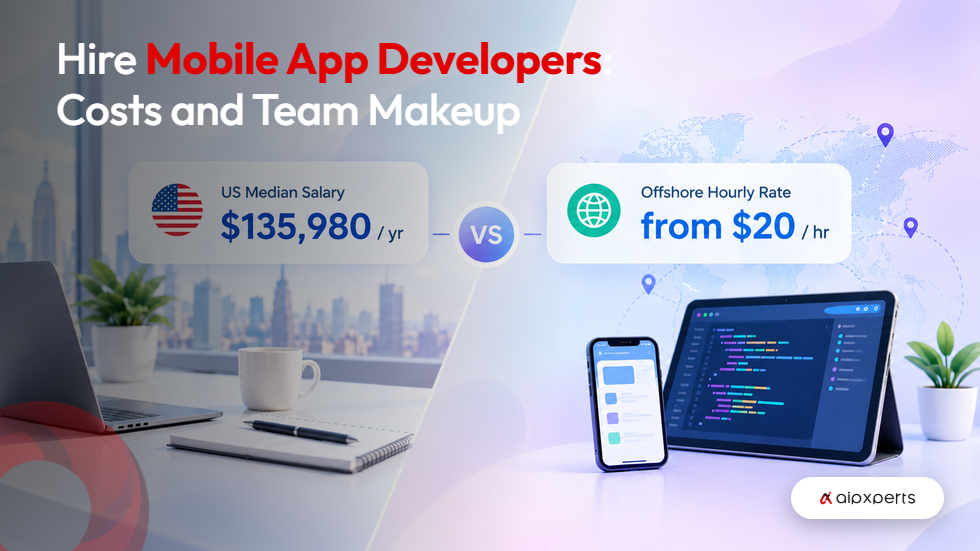
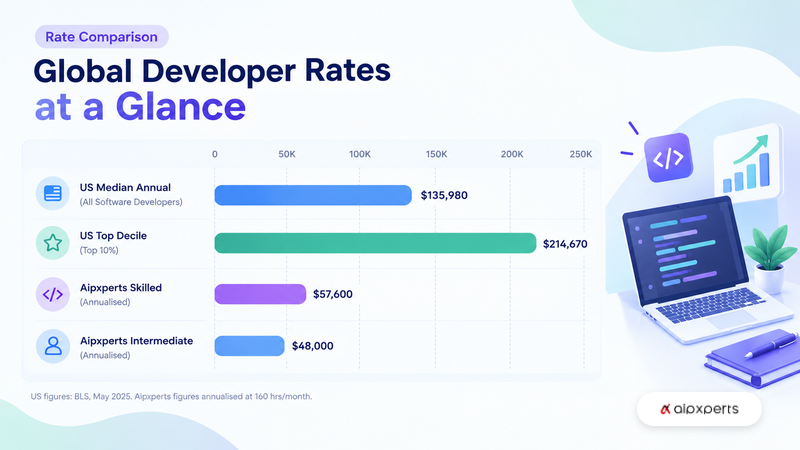
An app is the one kind of software where hiring a single developer almost never produces a shippable result, and where the second and third hires are not optional extras. Rates run from $20 an hour offshore against a US software developer median of $135,980, but the count matters more than the rate, and most budgets are built the wrong way round. These five steps put them back in order.
At Aipxperts we staff mobile app teams that range from two people to nine. Here is how to work out which one you need, what each costs, and what goes wrong when the maths is done backwards.
1. What Mobile App Developers Cost in 2026
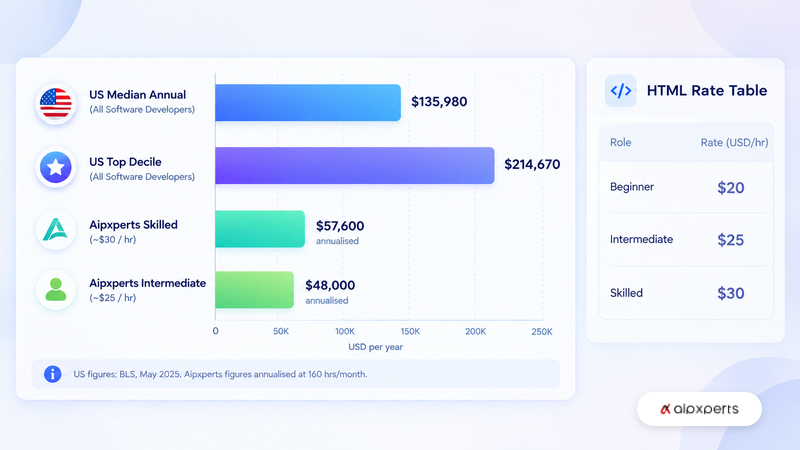
The public benchmark worth trusting is the Bureau of Labor Statistics, which recorded a $135,980 median annual wage for software developers in May 2025, spanning under $82,460 at the tenth percentile to over $214,670 at the ninetieth. There is no platform split in that data. A US W-2 hire then costs another 25% to 35% on top of base in payroll tax, benefits and recruiting fees.
Mobile app developers sit in our development band at Aipxperts:
| Level | Hourly | Weekly (40 hrs) | Monthly (160 hrs) |
|---|---|---|---|
| Beginner | $20 | $800 | $3,200 |
| Intermediate | $25 | $1,000 | $4,000 |
| Skilled | $30 | $1,200 | $4,800 |
Rates in USD. Monthly assumes 160 hours. Compliance-heavy work is quoted separately.
A warning about the app cost tables you will find elsewhere. Search this topic and you will hit long tables giving a price per app type, from $40,000 for something basic up to several hundred thousand for anything with the word enterprise in it. Almost none of them cite a source, and the ranges are wide enough to be unfalsifiable. They are useful for one thing only, which is telling you that complexity drives cost. They cannot price your app, because the variable that matters is scope, and nobody publishing a table has seen yours.
What you can price reliably is people multiplied by weeks. That is why the next two sections matter more than any cost table.
2. Step 1: One Team or Two
Every other number on this page is downstream of this choice, so make it first and make it deliberately.
One platform first. Pick the platform your users are actually on, ship it, learn, then decide about the second. This is the cheapest route to a real product and the one most founders talk themselves out of because it feels like doing half the job. It usually is not. If your analytics or your market says one platform holds most of your audience, building for the other one at the same time doubles your cost to serve a minority you have not validated.
Cross-platform, one team. Flutter or React Native, one codebase, both stores. Suits products where the app is a means of access rather than the product itself: booking, ordering, account management, internal tools. Cheaper than two native teams and not by half, because platform-specific work does not disappear, it just shrinks. Our comparison of the cross-platform frameworks covers which to pick.
Native, two teams. Separate iOS and Android engineers. Right when the app is the product, when you are doing heavy camera, Bluetooth, audio or graphics work, or when you need platform features on release day rather than whenever a bridge catches up. It is the most expensive option and sometimes the only honest one.
The failure mode is choosing native for both platforms on a budget that only supports one team, then discovering at month three that the Android build is four sprints behind. Decide the model against the budget you actually have, not the one you hope to raise.
3. Step 2: Everyone Else the App Needs
This is the section missing from every competing guide, and it is where budgets break.
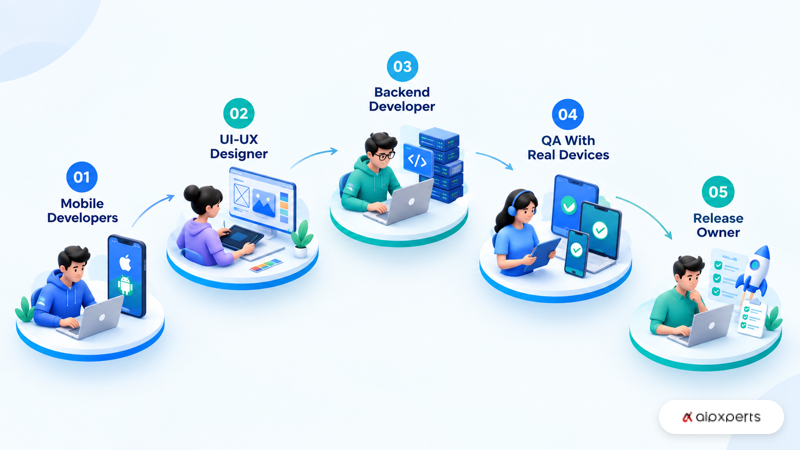
An app is more than code. It is a designed interface, a backend, a release process and a device-testing capability. If you hire only developers, those jobs still exist and they get done badly by people who were hired for something else.
| Role | Needed when | Typical share of budget |
|---|---|---|
| Mobile developer(s) | Always | The core of it |
| UI/UX designer | Always for anything user-facing | Often underestimated |
| Backend developer | Any app with accounts, sync or payments | Frequently forgotten entirely |
| QA with real devices | Always. Emulators miss the bugs that matter | Small, and skipping it is expensive |
| Someone owning store releases | From the first submission onward | Small but must be named |
Two practical points. A designer is not optional on a consumer app; the store is a visual marketplace and users judge in seconds. And a backend developer is the line most often missing from a first budget, because the app is the visible part and the API is not. If your app has logins, syncing or payments, someone is building and running that, and it is usually not your mobile developer.
Our UI/UX design and software testing work exists as separate disciplines for this reason rather than as add-ons.
If the budget will not stretch to the full set, that is a strong argument for building an MVP with a deliberately cut scope rather than a full app with missing roles.
4. Step 3: What to Screen For
Three things to screen for whenever you hire mobile app developers, whichever platform or framework you land on.
Start with store release experience. Ask how many apps they have taken through review, and what got rejected. Everyone who has shipped has been rejected for something, and the answer tells you whether you are talking to someone who has completed the loop or only written code. A developer who has never submitted an app does not know what the last two weeks of a project feel like.
Second, offline and poor connectivity. Mobile users are on trains, in basements and in warehouses. An app that assumes a working connection will fail in the field and look fine in the office. Ask what happens when a request fails halfway through. Good answers involve queueing and retry. Weak answers involve a spinner.
Third, app size and startup time. Both are commercial concerns, not engineering vanity. Large downloads lose installs on slow connections and metered data, and a slow cold start loses users who will not wait. A developer who has never measured either has not been held to the numbers that matter after launch.
Worth having but not disqualifying: analytics and crash reporting integration, CI for builds, and any experience with staged rollouts.
5. Step 4: Four Questions Worth Asking
- “How many apps have you had rejected from a store, and why?” Zero rejections across a real career means either very few submissions or a memory problem. You want a specific reason and what they changed.
- “The user fills in a form on the train, goes through a tunnel, and hits submit with no signal. What happens?” You are listening for the request being held and retried rather than lost, and for the user being told the truth about what happened.
- “Our app is 180MB and installs are dropping. Where do you look first?” Assets and bundled resources before code, almost always. Someone who starts by talking about code size has not done this.
- “Who should own the store account and the signing keys, us or you?” The right answer is you, the client, with the developers given access. Anyone who argues for holding your keys and your listing themselves is describing a situation that is painful to unwind later.
That third question is not hypothetical. On a children’s education app Aipxperts worked on, the single largest win in a release cycle came from cutting the download from 162MB to 79MB. No new features. Fewer abandoned installs on slow connections, which is a commercial result reached through an engineering decision. You can read more of that from the client side in our customer success stories.
6. Step 5: Where to Look
| Channel | Typical rate | Best for | Watch out for |
|---|---|---|---|
| Freelance marketplaces | $25–$80/hr | One platform, bounded scope | No designer, no QA, no device coverage |
| Vetted talent platforms | $60–$150/hr | Fast senior placement | You are still assembling a team yourself |
| Job boards, direct hire | Salary + 20% fee | Long-term product ownership | 8–14 weeks, and you need several hires |
| Development agencies | $20–$60/hr | A complete team including design and QA | Ask who is assigned, not who was in the pitch |
| Referrals | Varies | Trusted individuals | Does not scale to a full team |
The channel choice when you hire mobile app developers differs from other roles, because of the section above. A marketplace gives you a developer. An app needs a team. If you go the marketplace route, you are taking on the job of assembling design, backend, QA and release ownership yourself, and that is a real job rather than an afterthought.
7. Red Flags at Every Step
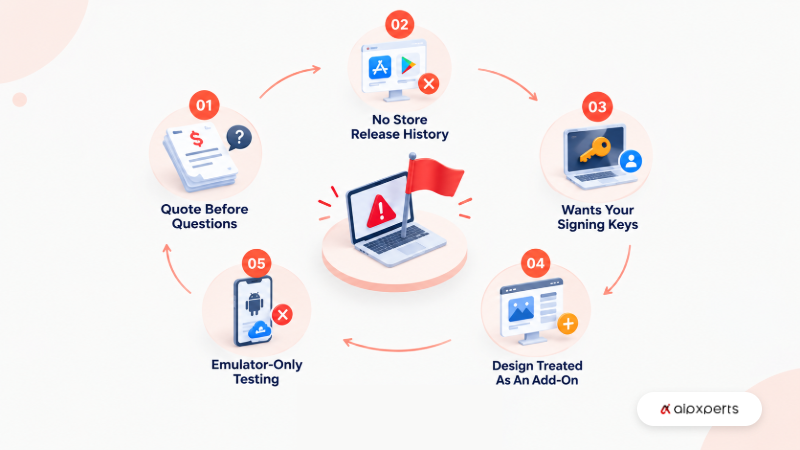
- A quote before any questions. Platforms, backend, offline behaviour: none of these are knowable from a one-paragraph brief. A same-day number priced without them is a number that will move.
- No store release history. Covered above. Writing an app and shipping an app are different jobs.
- Wanting to hold your store account or signing keys. Ask for it in your name from day one. Recovering a listing from a former supplier is slow and occasionally impossible.
- Design treated as an add-on. A supplier who quotes developers and offers to “add design later” is quoting for half the work.
- Emulator-only testing. Ask what physical devices they test on. The answer separates suppliers who will find your bugs from suppliers whose users will.
8. How Long Each Hire Takes
| Role | Time to place | Why |
|---|---|---|
| Cross-platform developer | 2–3 weeks | Largest and most active pool |
| Native Android or iOS | 2–4 weeks | Solid supply at mid level |
| Skilled native, either platform | 4–6 weeks | Thinner, usually employed |
| Full team incl. design and QA | 4–8 weeks | You are placing four roles, not one |
| Hardware or regulated domain | 6–10 weeks | Bluetooth, health and payments narrow it sharply |
The row people miss is the fourth. Placing one developer takes weeks. Assembling a working app team takes longer, and if you need to launch by a date, that is the number to plan against.
9. Which Engagement Model Covers Which Roles
| Staff augmentation | Dedicated team | Fixed-scope project | |
|---|---|---|---|
| Who directs the work | Your manager | Our delivery lead | Our delivery lead |
| Suits | An existing app and a roadmap you own | A new app, or one handed over completely | A defined piece: one flow, a migration, a rebuild |
| Covers design and QA | No, you supply them | Yes | Yes, within scope |
| Ramp-up | 1–2 weeks | 2–4 weeks | 2–3 weeks incl. discovery |
| Billing | Hourly, per engineer | Monthly, per team | Fixed price |
| Changing scope | Any time | At a sprint boundary | Change request only |
| Who owns store releases | You | Us, or shared | You, after handover |
| Goes wrong when | You needed a team, not a pair of hands | You want to direct daily work anyway | Requirements are still moving |
The third row is the one that decides most app engagements. Staff augmentation works when you already have design and QA and are short on engineering. If you are starting from nothing, a dedicated team that includes those roles is usually cheaper than assembling them yourself, and considerably faster.
10. Four Ways App Budgets Break
- Budgeting for mobile developers and forgetting the rest. The single most common way an app budget goes wrong. Design, backend, QA and release ownership are not optional, and discovering them at month two means either a bigger budget or a worse product.
- Building for both platforms before validating either. Doubling the cost to reach an audience you have not yet proved wants the thing.
- Treating the launch as the finish. Apps need maintenance in a way websites do not. Operating systems update annually, stores change their requirements, and an app left untouched for two years often will not build, let alone ship. Budget for it or plan to rewrite.
- Hiring one developer for both platforms at a mid-level rate. People who are genuinely strong at native iOS and native Android exist, are rare, and are priced accordingly. If the budget only supports one person, that is a cross-platform decision.
11. How Aipxperts Staffs App Teams
Our mobile app development work starts from your device list and your platform decision rather than a feature list, because those two things set everything else: the minimum OS version, the testing budget, and which platform capabilities you can use at all.
What that means in practice: named engineers with CVs and a call before anything is signed, a straight answer on which apps they have shipped and to which stores, and rates that hold rather than opening a negotiation.
The honest counterpart. If you have a validated product and simply need more hands on an existing app, an agency team is more structure than you need and augmentation will cost you less. If you have an idea and no users yet, the useful first step is usually a deliberately cut MVP on one platform, not a full app on two. And if nobody on your side can review code or make product decisions weekly, no engagement model fixes that, so it is worth solving first.
12. Frequently Asked Questions
How much does it cost to hire mobile app developers?
Aipxperts rates are $20 an hour for beginner, $25 for intermediate and $30 for skilled, which is $3,200 to $4,800 a month per person at 160 hours. Multiply by the number of roles you actually need, which is rarely one. In-house in the US is a different sum: BLS recorded a $135,980 median for software developers in May 2025, with payroll tax, benefits and recruiting adding a quarter to a third on top.
How many people do I need to build an app?
Rarely fewer than three: a mobile developer, a designer, and someone doing QA on real devices. Add a backend developer if the app has accounts, sync or payments, which most do. A single developer can build a simple app alone, but nobody should plan a consumer product that way.
Should I build native or cross-platform?
Cross-platform if the app is a means of access and you need both stores on one budget. Native if the app is the product, or if it leans on camera, Bluetooth, audio or graphics. Our cross-platform frameworks comparison covers the trade-off properly.
How long does it take to hire an app team?
Two to four weeks for a single developer. Four to eight weeks to assemble a full team including design and QA. Plan against the second number if you have a launch date.
Who should own the App Store and Play Store accounts?
You should, in your organisation’s name, with your developers given access. This is routinely done the other way round and it is painful to unwind when the relationship ends.
What does an app cost to build?
Honestly, nobody can tell you from a blog post, and the tables that claim to are guessing. What can be estimated is team size multiplied by weeks once scope is defined. For a worked example on one app type, see our breakdown of the cost of developing a food delivery app.
What happens after launch?
Budget for it. Operating systems update every year, stores change their requirements, and an app nobody has touched in two years often will not build. Ongoing maintenance is a smaller line than the build and it is not optional.
Building an App and Not Sure Whether You Need One Developer or a Team?
Tell Aipxperts what the app does, which platforms your users are on, and what you already have in design and QA. We will tell you honestly which shape fits.
Get in Touch