
Android is the only major platform where your code has to survive hardware the person who wrote it has never touched.
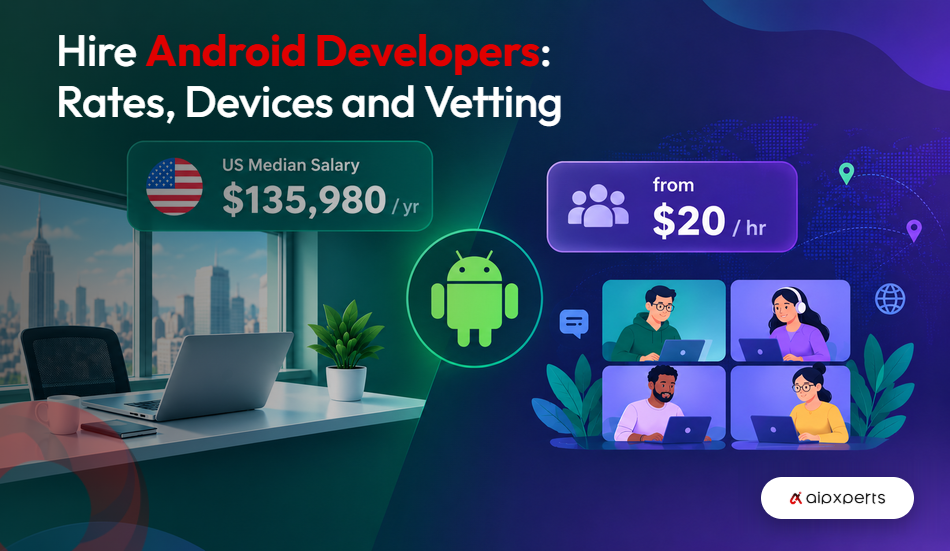
An iOS engineer targets a few dozen devices from one manufacturer. An Android engineer targets thousands from hundreds, running vendor-modified versions of the operating system, each with its own rules about what a backgrounded app is allowed to do. Rates start at $20 an hour offshore against a US software developer median of $135,980, but the rate is the easy part of this decision.
That is what separates an Android developer from someone who has written an Android app. At Aipxperts we screen for it directly, and this page explains how.
1. What Android Developers Cost in 2026
Two numbers, answering different questions.
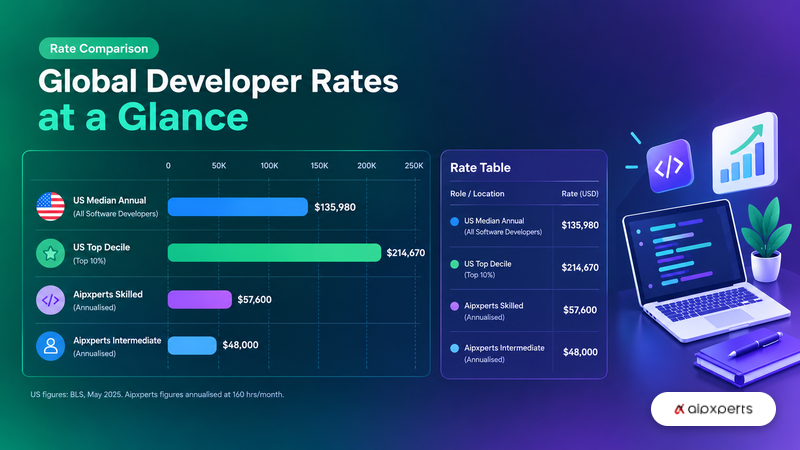
Start with the public benchmark. The Bureau of Labor Statistics recorded a $135,980 median annual wage for software developers in May 2025, with the tenth percentile under $82,460 and the ninetieth over $214,670. There is no platform breakdown, and be sceptical of anyone offering an Android-specific US figure to the dollar: the salary aggregators are $30,000 apart on the same role in the same year. On top of whatever base you agree, a US W-2 hire adds another quarter to a third again in payroll tax, benefits and recruiting fees.
Then what an agency charges. Android sits in our development band at Aipxperts:
| Level | Hourly | Weekly (40 hrs) | Monthly (160 hrs) |
|---|---|---|---|
| Beginner | $20 | $800 | $3,200 |
| Intermediate | $25 | $1,000 | $4,000 |
| Skilled | $30 | $1,200 | $4,800 |
Rates in USD. Monthly assumes 160 hours. Compliance-heavy work is quoted separately.
One cost that hiring guides consistently leave out: real devices. Emulators do not reproduce the bugs that matter on Android, and a team testing only on emulators and their own handsets will ship defects that reach your users first. Budget either for a modest device rack covering the manufacturers your analytics actually show, or for a cloud device farm. It is a small line item that prevents an expensive category of problem.
2. Native, Kotlin or Cross-Platform
Settle this before you write the job description. It changes who you are looking for, what you should pay, and whether you need to hire Android developers at all or a cross-platform team instead.
Native Android in Kotlin is the default for anything where the app is the product. Kotlin is the language Google builds for first, and a native codebase gets new platform capabilities on the day they ship rather than whenever a bridge catches up.
Java still appears, mostly in older codebases. A developer who only writes Java is not automatically a problem, but on a new build it is a signal worth understanding. Our comparison of Kotlin and Java for Android covers the technical trade-off properly.
Cross-platform, meaning Flutter or React Native, is a different hire entirely. It suits products that need both platforms with one team and where the app is a means of access rather than the product itself. It suits games, heavy camera or Bluetooth work, and anything needing same-day platform features considerably less well. We wrote up the cross-platform framework options separately, and if you are building for both platforms it is worth reading before you hire, because a cross-platform engineer and a native Android engineer are not interchangeable in either direction.
If you already know you need both platforms natively, you are running two hires, not one, and our iOS and Android work is staffed separately for that reason.
3. The Three Skills That Actually Matter on Android
Three things, and none of them is “knows Kotlin”.
Start with coroutines and structured concurrency. Almost every meaningful Android operation is asynchronous, and coroutines are how that is expressed now. The useful question is not whether they use them but whether they can explain what happens to an in-flight network call when the user rotates the screen or backs out. A developer who has only used coroutines as a nicer callback will not have an answer.
Second, lifecycle and process death. Android will kill your app’s process while it is in the background and then restore the user to where they were. A developer who has shipped a real app knows this and has handled it. One who has not will assume a ViewModel is enough, which is wrong in a specific and testable way. This single topic separates people faster than any other Android question.
Third, current UI. Jetpack Compose is where the platform is going and where most new work is written. Someone building entirely in XML layouts is not disqualified, particularly for maintenance work on an existing app, but they should be able to tell you why and what the migration would involve.
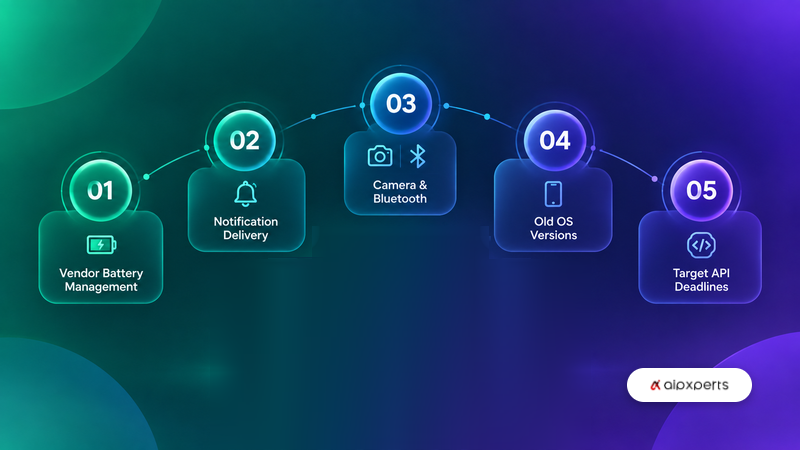
Worth having but not disqualifying: Play Console release experience, Gradle build configuration beyond the defaults, and anything involving Bluetooth, camera or background location, which are the three areas where Android reality diverges most from documentation.
4. Four Questions, Four Revealing Answers
Each has a right answer and a revealing wrong one.
- “The app works on your phone and crashes on a mid-range Samsung. Walk me through finding out why.” You want a diagnostic order: reproduce it, get the stack trace off the actual device, check what the manufacturer changed. Anyone who guesses at a cause before getting the trace is guessing.
- “The user is on a form, backgrounds the app for twenty minutes, and comes back. What happens to what they typed, and what do you do about it?” The answer involves saved state that survives process death. A
ViewModelalone is not enough, because it is cleared when the process is killed. Candidates who have only ever tested by leaving the app open for thirty seconds do not know this is a question. - “You need to sync data every hour, even when the app is closed. What do you reach for?”
WorkManager, with an understanding that the operating system decides the timing and that aggressive manufacturer battery settings will delay it. Anyone promising a reliable exact-hour sync on all devices has not shipped to a wide device base. - “You inherit an app with a two-star rating and a 4% crash rate. What do you do in week one?” No single right answer, but the good ones start with reading the crash reports rather than the code, and grouping by device and OS version before touching anything.
5. Device Fragmentation is the Whole Job
Everything above is downstream of one fact: you cannot test Android on Android. You test it on specific devices.
The differences that break apps are not the ones people expect. Screen sizes are largely solved. What is not solved is manufacturers shipping their own aggressive battery management that kills background work, notification behaviour that varies by vendor, camera implementations that report capabilities they do not have, and OS versions that stay in service for years after Google has moved on.
Two practical consequences for hiring.
First, ask any candidate which devices they tested on in their last project, and why those. A strong answer references the analytics: these were the handsets our users actually had. A weak answer is a list of flagships, which tells you they tested on what was in the office.
Second, ask what they do about Google Play’s target API requirement. Play enforces a minimum target API level to keep an app updatable, and that level moves every year. Apps get quietly locked out of updates because nobody owned this. A developer who has been through it will describe it as routine maintenance. One who has not will not know it exists, and that is a genuine operational risk rather than a knowledge gap.
This is also why our Android development work starts from a device list rather than a feature list, and why testing is scoped as part of the build rather than bolted on at the end.
6. Where to Find Android Developers
| Channel | Typical rate | Best for | Watch out for |
|---|---|---|---|
| Freelance marketplaces | $25–$70/hr | Short bounded tasks | No device coverage of their own |
| Vetted talent platforms | $60–$150/hr | Fast senior placement | The vetting premium is most of what you pay |
| Job boards, direct hire | Salary + 20% fee | Permanent app ownership | 8–14 weeks elapsed, counter-offers |
| Development agencies | $20–$60/hr | Ongoing capacity plus a device rack | Ask who is assigned, not who was in the pitch |
| Android communities | Varies | Genuine platform specialists | Slow, does not scale past a couple of hires |
One channel-specific point for Android. Ask a freelancer or platform what devices they test on. Agencies and in-house teams usually have a physical device rack or a device-farm subscription. Individual contractors often have one or two handsets, which is fine for a simple app and a real gap for anything touching hardware.
7. What Should Worry You in a Candidate
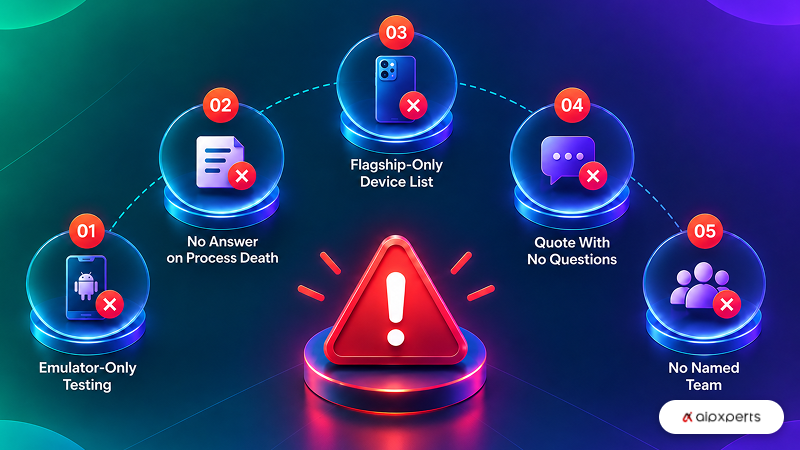
- Emulator-only testing. The single most reliable predictor of post-launch surprises. Ask directly and listen for physical devices.
- No answer on process death. Covered above. It is testable in one question and it separates shipped-an-app from built-an-app.
- Flagship-only device lists. Testing on the newest hardware tells you almost nothing about the phones your users hold.
- A quote before any questions. Nobody can price Android work without knowing your device targets, your minimum OS version and whether background work is involved. A same-day number with no discovery will move.
- No named individual. If the person in the sales call is not the person who writes the code, that gap is where most disappointment comes from. Ask who specifically, and speak to them.
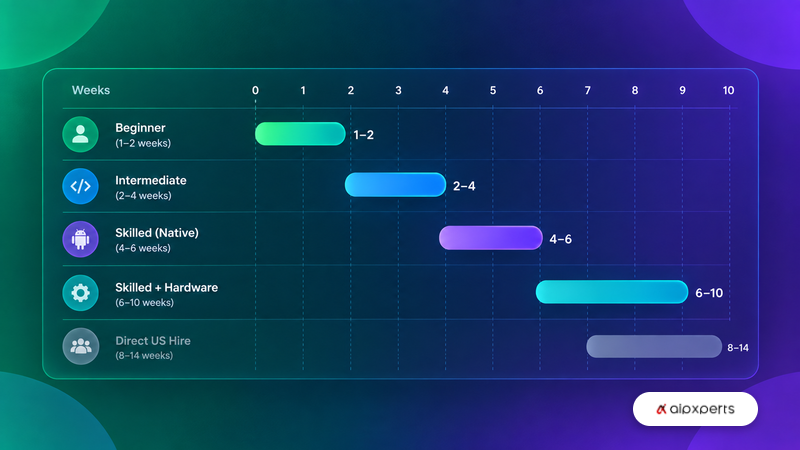
8. Realistic Time to Hire
| Level | Time to place | Why |
|---|---|---|
| Beginner (0–2 yrs) | 1–2 weeks | Deep pool |
| Intermediate (3–5 yrs) | 2–4 weeks | Most in-demand band |
| Skilled (5+ yrs), native Kotlin | 4–6 weeks | Thinner than the headline pool suggests |
| Skilled + hardware or regulated domain | 6–10 weeks | Bluetooth, camera, health or payments narrows it sharply |
Direct US hiring runs longer than all of these, mostly because notice periods and counter-offers add weeks no process improvement removes.
9. Choosing an Engagement Model for App Work
Almost nobody in this search result publishes a straight comparison, so here is one.
| Staff augmentation | Dedicated team | Fixed-scope project | |
|---|---|---|---|
| Who directs the work | Your manager | Our delivery lead | Our delivery lead |
| Suits | An existing app and a roadmap you own | A new app, or an app handed over completely | A defined piece: a rewrite of one flow, a migration |
| Ramp-up | 1–2 weeks | 2–4 weeks | 2–3 weeks incl. discovery |
| Billing | Hourly, per engineer | Monthly, per team | Fixed price |
| Changing scope | Any time | At a sprint boundary | Change request only |
| You must supply | Backlog, code review, direction | Product priorities and a device list | A settled specification |
| Who owns store releases | You | Us, or shared | Usually you, after handover |
| Goes wrong when | Nobody your side reviews code | You want to direct daily work anyway | Requirements are still moving |
That release-ownership row matters more on mobile than anywhere else. Web work ships when you say so. An app ships when a store review says so, and someone has to own the console, the signing keys and the rollout. Decide who that is before the engagement starts, not at the first release.
Most Android work we place is a dedicated team or staff augmentation depending on whether you have an app already. If the app is one part of a wider product, our mobile app development work covers both platforms together.
10. The Mistakes That Cost the Most
- Hiring one developer for both platforms. Someone strong in native Android and native iOS exists but is rare and priced accordingly. If the budget only supports one person and you need both platforms, that is a cross-platform decision, and it should be made deliberately rather than discovered halfway through.
- Skipping the device conversation until testing. Your device targets change architecture decisions, minimum OS version and effort. Agreeing them at the start costs an hour. Discovering them during QA costs weeks.
- Treating offline as an edge case. On a driver-facing logistics app Aipxperts built, the users spent much of the day in warehouses and loading bays with no usable signal. Offline handling was not a nice-to-have refinement, it was the product. Any app whose users move through the physical world needs that decided at architecture stage, because retrofitting it means rewriting the data layer. Our customer success stories have more from clients on how that played out for them.
- Underestimating the review load. Staff augmentation means someone your side reads the code. If nobody has three hours a week, you want a team that reviews its own work.
11. How Aipxperts Builds Android Teams
Our Android development work starts from your device list, which is a deliberate choice rather than a slogan. The list decides the minimum OS version, how much of the budget goes to testing, and which platform features are available to you at all. Starting anywhere else means revisiting those decisions later at a worse time.
In practice that means three things. Named engineers with CVs and a conversation before anything is signed. A straight answer on which apps they have shipped and to how many devices. And the rates above holding, rather than being an opening position.
The honest counterpart. If your app is genuinely simple and you need both platforms on one budget, a cross-platform build will serve you better than two native hires, and we would rather say that early. If nobody internally can review incoming code, augmentation is the wrong model. And if you have no analytics on what devices your users hold, the most useful first step is not hiring a developer, it is finding that out, because it changes the brief.
12. Frequently Asked Questions
How much does it cost to hire Android developers?
Aipxperts rates are $20 an hour for beginner, $25 for intermediate and $30 for skilled, which is $3,200 to $4,800 a month at 160 hours. An in-house US hire works out very differently. BLS put the median software developer wage at $135,980 in May 2025, and payroll tax, benefits and recruiting fees add another 25% to 35% on top. Either way, budget separately for real test devices or a device farm.
Should I hire native Android or cross-platform?
Native Kotlin if the app is the product, if it uses camera, Bluetooth or heavy background work, or if you need platform features the day they ship. Cross-platform if you need both platforms on one budget and the app is a means of access rather than the product. Our cross-platform frameworks comparison goes into the trade-off.
Do I need a Kotlin developer or a Java developer?
Kotlin for new work. Java experience is still relevant for maintaining older codebases, and most experienced Android developers read both. We compare them in Kotlin vs Java for Android.
How quickly can you place an Android developer?
One to two weeks at beginner level, two to four at intermediate, four to six for skilled native engineers. Hardware-adjacent or regulated work such as health or payments pushes it to six to ten.
What is the single best question to ask an Android candidate?
What happens to the user’s unsaved input when Android kills the app’s process in the background. It takes a minute, needs no code, and reliably separates developers who have shipped a real app from developers who have built one.
Who owns the code and the Play Store listing?
You should own both. The contract needs to say the code and all derivative work transfer to you on payment, and the Play Console listing should be under your organisation’s account with your developers given access, rather than the other way round. That second point is routinely missed and is painful to unwind later.
Can the same developer handle Android and iOS?
Some can, most cannot do both at a senior level, and the ones who can are priced accordingly. If you need both platforms natively, plan for two hires or a mobile team.
Need Android Engineers Who Test on the Devices Your Users Actually Hold?
Tell Aipxperts what the app does, which handsets show up in your analytics, and who will be reviewing the code.
Get in Touch