Machine Learning Development Services Judged on the Decision, Not the Accuracy
A model at ninety per cent accuracy can be worthless and a model at seventy can be transformative, depending entirely on what happens next. Our machine learning development services start from the decision the model is meant to change and work backwards to whether one is needed at all.
Test a Decision Against a Baseline 5.0
5.0 5.0
5.0 4.3
4.3 4.8
4.8The Question That Comes Before Any Model
Not what to predict. What somebody would do differently if they knew, and whether they would actually do it.
A prediction is only worth what the action behind it is worth. A churn model is valuable if somebody intervenes with the customers it flags, and worthless if nobody has capacity to. A demand forecast changes purchasing or it changes nothing. So the first conversation here is about the decision, its frequency and what a wrong call costs in each direction, because those three settle whether a model is worth building and what it has to achieve to be useful.
The second thing established is the baseline. What accuracy does the current approach achieve, whether that is a rule, a spreadsheet or an experienced person’s judgement? Surprisingly often it is high, and a model has to beat it by enough to justify being built and maintained. Teams that skip this measure their model against zero and declare success against nothing.
If the training data does not exist in usable form yet · If the question is what happened rather than what will
Our Machine Learning Team, in Numbers
The engineers, models delivered and retention behind our prediction work.
60+
AI Engineers
50+
AI Solutions Delivered
80+
AI-Integrated Workflows
30+
Industries Served
95%
Client Retention
Our Machine Learning Development Services, and What Each One Delivers
Each service below can be engaged on its own. Feasibility framing and data readiness decide whether any of the rest happen, and they are the two clients most often want to skip, which is why so many models never reach production.
Machine Learning Consulting and Feasibility
We work out whether a model would genuinely improve the decision you have in mind: how often it gets made, what being wrong costs in each direction, and how well your current approach already does. You leave knowing whether to build, and often with a cheaper fix that works instead, such as a rule, a report or a better threshold on what you already run.
Data Readiness Assessment
We tell you whether your data can carry a model before you spend anything building one: whether the history exists, whether the labels can be trusted, and whether the fields you would predict from are available at the moment you need them. It is what spares you the most expensive failure in machine learning, a model that scores brilliantly in testing and can never be deployed.
Custom ML Model Development and Evaluation
We build and compare candidate models, judge them against your existing process on the real decision rather than on abstract accuracy, and set the operating point to match what your team can act on. You get a working model, the number it beats, and an honest account of what it does worse than what you run today.
Forecasting and Demand Modelling
We forecast demand, volume or consumption where seasonality, promotions and outside events move the numbers more than the algorithm does. You get forecasts your planners can actually use, usually from a simpler model than expected, which matters because a simple forecast is one your own team can keep running without us.
Predictive Scoring, Classification and Ranking
We score, sort and rank whatever you have too much of to work through by hand, from leads and claims to tickets and transactions, with the cut-off set to the volume your team can genuinely clear. You get a queue people trust and act on, rather than a flag list that quietly gets ignored.
MLOps, Monitoring and Drift Detection
We put the model into the process it is meant to improve, then keep it honest afterwards by watching whether the world it learned from still resembles the one it is running in. You hear that performance has slipped from a monitor rather than from a complaint, because models decay quietly and nothing in the output announces it.
Model Rescue and Handover
We take over a model somebody else built and left you holding: what it does, whether it still performs, and whether anyone on your side can retrain it. You end up with a model your own team can run, or a clear recommendation to retire it, which is frequently the more valuable answer when no baseline was ever recorded.
Machine Learning Models in Production, and What They Changed Downstream
Look past the accuracy figure on each card to what somebody did differently afterwards. A model nobody acted on is a research project with a client’s name attached.
Marketplace
An AI Freelance Marketplace Platform That Turns Site Audits Into One-Click Hires
Nine years with one client, and the most recent phase changed what the product is. Legiit went from listing gigs to telling a business what is wrong with its website and which seller can fix it.
Read case study: An AI Freelance Marketplace Platform That Turns Site Audits Into One-Click HiresMarketplace
Building the AI Layer Behind a Live Marketplace Without Touching Checkout
The marketplace was already live and taking payments, which ruled out rebuilding it. The AI layer runs as a separate FastAPI service, so models can change without redeploying the code that handles checkout.
Read case study: Building the AI Layer Behind a Live Marketplace Without Touching CheckoutWhat Our Clients Report Back
In their own words, from the platforms that verify an engagement before publishing a review.

Our experience working with Aipxperts has been exceptionally satisfying. From start to finish, they handled the project with professionalism and responsibility. Communication was seamless, and they effectively addressed our requirements, delivering high-quality results on time. Their technical expertise was particularly impressive, as they effortlessly solved complex problems. We highly recommend Aipxperts for their outstanding service and dedication to client satisfaction.

Hardik was very helpful in advice and completing the work.
Prediction Work by Industry, and What Usually Trips It Up
Each entry names the machine learning work we most often deliver in that industry, the prediction behind it, and the reason it disappoints, which is nearly always about data rather than about modelling.
Retail
Demand and allocation by location, where promotions distort history and the model learns the promotion rather than the demand. In retail, marking promotional periods in the training data matters more than the algorithm.
eCommerce
Propensity, basket and returns prediction, where the returns signal arrives weeks after the sale. For eCommerce, building that delay into the evaluation separates a model that works from one that looked excellent in testing.
Health and fitness
Lapse and re-engagement prediction, where a gap in device data looks identical to genuine inactivity. In health and fitness, separating those two is usually the first real piece of feature work and it decides everything after it.
Fintech and financial services
Risk, fraud and collections scoring, where the model must be explainable to somebody outside the business and where the cost of a false positive falls on a customer. In fintech and financial services, both constrain the modelling before accuracy does.
Energy and utilities
Demand and consumption forecasting against weather and calendar effects, plus asset failure prediction for energy and utilities, where the failures are rare enough that the imbalance decides the design.
On-demand platforms
Supply and demand density by area and hour for on-demand platforms, where the thing you most want to predict is unfulfilled demand and it does not appear in your data by definition.
Manufacturing
Quality and maintenance prediction in manufacturing, where the events worth predicting are rare enough that class imbalance is the whole problem and a naive model achieves excellent accuracy by predicting nothing.
What Aipxperts Insists On Before Building a Model
Positions we hold on prediction work, including one that costs us more engagements than all the others combined.
01A baseline is measured before any model is builtWhat the current rule, spreadsheet or experienced person already achieves. A model that does not beat that clearly is not worth deploying, let alone maintaining, and the comparison is cheap to run.
02The evaluation is on the decision, not on the metricAn operating point chosen against what a false positive and a false negative actually cost your business, rather than a threshold that maximises a statistic nobody outside the project understands.
03Availability at prediction time is checked before anything is trainedThe single most common way a model dies between the laboratory and production is being trained on a field that is not populated when the prediction has to be made. This gets checked in the readiness assessment, not discovered at deployment.
04Simple first, and often simple is where it endsLogistic regression and gradient boosting with well-constructed features beat elaborate architectures on most business problems, and they are dramatically easier to explain, deploy and retrain. We start there and escalate on evidence.
05And the recommendation that is not a modelA meaningful share of enquiries here are better served by a rule, a threshold change or a report. Those are cheaper, more explainable and easier to keep working, and where that is the answer you will get it on the first call.
Why Accuracy Is Almost Always the Wrong Number
Accuracy is the figure everybody asks for and it is close to useless on its own. What follows is what to ask instead, and it applies to any supplier you are evaluating.
On rare events, accuracy is trivially high and completely worthlessIf two per cent of transactions are fraudulent, a model that says “not fraud” every time is ninety-eight per cent accurate and catches nothing. Any supplier quoting accuracy on an imbalanced problem is either being careless or hoping you are.The two ways of being wrong cost different amountsFlagging a good customer as a risk costs goodwill and staff time. Missing a real risk costs money. Those are rarely equal, and the operating point should be chosen against that asymmetry rather than against a default threshold.The volume the model produces has to match the capacity to actA scoring model that flags five hundred accounts a week for a team that can review fifty has produced a queue rather than a decision. The threshold is a capacity decision as much as a statistical one, and it belongs to the operations manager.Ask what it is compared againstAgainst the current process, or against nothing? A model reported without a baseline cannot be evaluated. This is the single most useful question to put to any supplier and it is asked remarkably rarely.Ask how it will be known when it stops workingBehaviour changes, and a model trained on last year quietly becomes wrong. Drift monitoring is what turns that from a discovery into an alert, and a proposal without it is describing a project rather than a system.And the question that decides whether any of this mattersWho acts on the output, how often, and what do they do today instead? If nobody has capacity to act, the model changes nothing regardless of how good it is, and that is worth establishing in the first hour rather than the sixth month.
The Machine Learning Tech Stack We Build On
The modelling, feature, experiment tracking and deployment tools our engineers build on. Where your team will retrain the model afterwards, the choices are made for their ability to maintain it rather than for ours to build it.
 Python
 RSQL
RSQL JavaScript
 Java
Java Scala
Scala C++
C++
ML and deep learning frameworks
 TensorFlow
 PyTorch
 KerasJAX
 scikit-learnXGBoostLightGBMCatBoost
Libraries and toolkits
 NumPy
NumPy pandas
 SciPy
SciPy OpenCV
 Hugging Face Transformers
 spaCyNLTKstatsmodels
 Optuna
LLM and agent frameworks
 LangChainLlamaIndex
 Rasa
Rasa Haystack
Algorithms and model families
Linear and logistic regressiongradient boosted treesrandom forestsSVMk-means and DBSCAN clusteringARIMA and Prophet for time series CNNRNN and LSTMtransformersreinforcement learning
Data management and visualisation
 PostgreSQL
 MongoDB
 Snowflake
 BigQuery
 Databricks
 Apache Spark
 Apache AirflowKafka
 dbt
dbt Tableau
 Power BI
 Plotly
Model management and MLOps tooling
 MLflowKubeflow
 Weights & Biases
 DVC
DVC Docker
 Kubernetes
 Amazon SageMakerVertex AI
 Azure MLEvidently AIFeast
How Clients Rate the Work
Verified on Clutch, GoodFirms, Upwork and Google, across web, mobile and enterprise delivery since 2012.
Training Data, Model Ownership and Explainability
Prediction work uses your history and produces something that makes decisions about people or money. Both halves of that need boundaries.
Standards we deliver against
Data protection and privacyEU AI Act readinessAI ethics and model transparencyExplainable AI (XAI) practiceAlgorithm testing and validationGDPRHIPAA
Our Machine Learning Development Process, and Where We Stop
We measure the baseline your current process already achieves before proposing a model, which is why several of these stages regularly end the engagement with a useful answer and no model. That is a legitimate outcome here rather than a failure, and it is the main way this differs from a process that assumes the model is the deliverable.
01Decision framingWhat decision changes, who makes it, how often, and what being wrong costs in each direction. It can stop here where nobody has the capacity to act on a prediction, and that is worth knowing in week one.02Baseline measurementHow well the current rule, process or person already performs on the same decision. We stop here where the existing approach is already good enough that a model could not justify its own maintenance.03Data readiness assessmentWhether the history exists, whether labels are trustworthy, and whether features are available at prediction time. This usually redirects to data engineering, where the training data does not yet exist in usable form.04Feature constructionThe part that determines outcomes more than model choice does, and the part that requires knowing your business. Most of the performance in a business model comes from features rather than architecture, so this is where the real work sits.05Modelling and evaluation against the baselineCandidates built and compared on the decision, with the operating point chosen against real costs. It produces a comparison, including the honest case that the baseline won.06Deployment into the processInto the workflow where the decision is actually made, in a form the person making it can use. This stage decides whether any of the previous ones mattered, because a model outside the workflow gets ignored.07Monitoring, drift detection and retrainingPerformance watched over time, with a defined trigger and a documented retraining path your team can run. It prevents the silent decay that makes a model quietly wrong while everybody still trusts it.
Machine Learning Questions We Answer Before Any Build
Several answers below argue for something other than a model, which reflects how these conversations actually go.
Share your project vision
Tell us what you want to build. A specialist, not a salesperson, replies.
Tell Us the Decision, and Who Would Act on It
One repeated decision, roughly how often it happens, and what happens today when it goes wrong in each direction. That is enough to establish whether a model is worth building, what it would have to beat, and whether your data can support it.
Get a Baseline MeasuredLessons From Models We Have Shipped
Baselines, feature work and evaluation results from models our engineers put into production, written for the people who will maintain them.
-
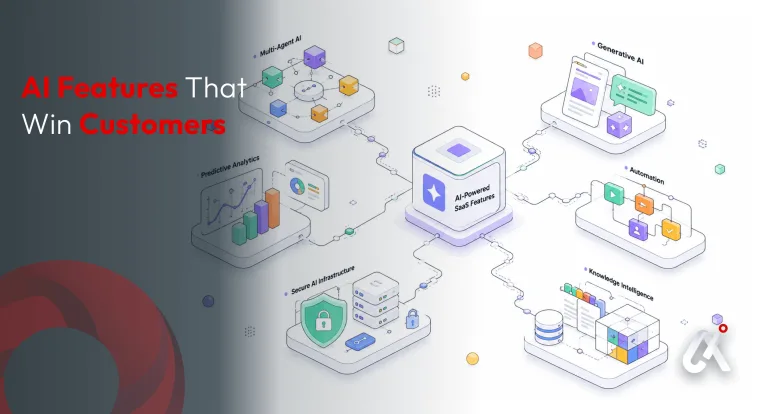
AI SaaS Features That Differentiate Your Product in 2026
The Software-as-a-Service (SaaS) industry in 2026 has crossed a critical threshold
-
Generative AI App Development: Transforming Web and Mobile in 2026
For forward-thinking CTOs, product managers, and enterprise decision-makers, staying competitive requires shifting away from legacy static architectures
-
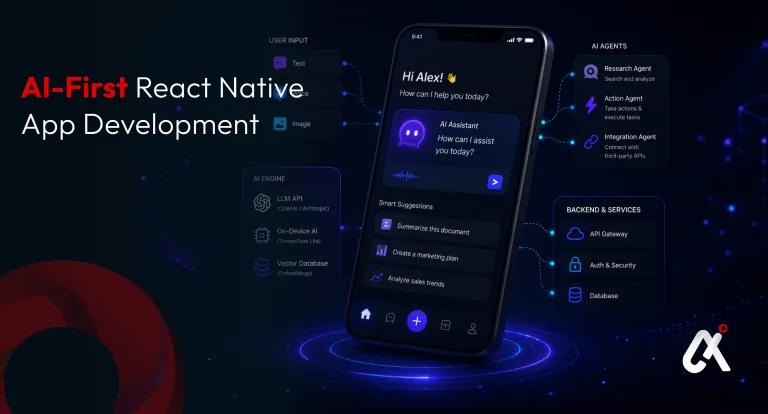
React Native AI: Building an AI-First Mobile App in 2026
A practical guide to AI-powered churn prediction, retention automation, and personalization for two-sided marketplace platforms