A Computer Vision Development Company That Starts With Your Images, Not a Model
Vision projects rarely fail at the modelling. They fail because the camera was in the wrong place, the lighting changed between morning and afternoon, or nobody could label the examples consistently. Our computer vision development services scope that part first, on a pilot built from your own images, so you know whether the task is learnable before you commit a budget to it.
Send Us a Hundred Images 5.0
5.0 5.0
5.0 4.3
4.3 4.8
4.8Where Computer Vision Projects Fail, and What We Do About It
Every part of this that sounds hard is the part that is well understood. Every part that sounds trivial is where the projects actually come apart.
Detection and classification are mature. Off-the-shelf architectures handle most industrial and commercial tasks competently, and the modelling is rarely where a project gets stuck. What gets it stuck is everything around the image: where the camera sits, whether the lighting is consistent through a day and a year, whether the object can be occluded, and whether two people labelling the same picture agree on what it shows.
That last one decides more than anything else. If two of your own experts disagree on whether an image shows a defect, no model will resolve the disagreement, it will learn the inconsistency. So the first work here is establishing that a consistent label is possible, which is a question about your process rather than about the technology.
If the input is a table rather than an image · If the AI approach is not settled yet
Our Computer Vision Team, in Numbers
The engineers and delivery record behind the vision work on this page.
60+
AI Engineers
50+
AI Solutions Delivered
80+
AI-Integrated Workflows
30+
Industries Served
95%
Client Retention
Our Computer Vision Development Services, and What Each One Needs From You
Each entry names what it needs on your side, because in vision work the client contribution is larger than in almost anything else on this site.
Computer Vision Consulting and Feasibility Pilot
We run a small, bounded test on real images from your environment, producing an honest read on whether the task is learnable before any budget is committed. We need a few hundred real images from you, including the awkward ones, not the clean examples somebody selected.
Object Detection and Counting
We find and count things in frames, where the difficulty is occlusion, overlap and objects at the edge rather than recognition itself. What we need from you is agreement on what counts as one object when two are touching, which is more contentious than it sounds.
Automated Defect and Quality Inspection
We classify what passes and what does not, on production output where the defect is often rare and always variable. This one needs examples of defects, which are scarce by definition, and two experts who agree on the borderline cases.
OCR and Document Data Extraction
We read text from photographs, scans and forms, including the ones that arrive skewed, creased or photographed on a phone at an angle. Send us the worst examples you receive: average-quality documents tell nobody anything about the failure rate.
Video Analytics and Event Detection
We detect events across frames rather than in single images: movement, dwell, sequence and absence. It needs a definition of the event precise enough that two people watching the same footage would mark it in the same place.
Capture and Camera Placement Assessment
We decide where cameras sit, what lighting they need and what a consistent image looks like across a full day and a full year. This work needs physical access, and a willingness to change the environment rather than only the software.
Edge and Cloud Vision Deployment
We run the model where the images are or where the compute is, decided against bandwidth, latency and what happens when the connection drops. We need an honest account of the connectivity at the site, which is usually worse than the office assumes.
Computer Vision Projects We Have Delivered, and What the Pilot Established
Each card names what the pilot established before any build began. Where a card shows a pilot that stopped instead, that is the pilot doing its job: establishing that a task is not learnable from the images available is a result, and a cheap one.
Healthcare
A Custom Booking and Payment Platform for a Five-Studio UK Scan Group
Nearly every payment across these five UK scan studios was still settled by phone or in person, because the previous system could not process online payments reliably. Customers now book and pay on the site.
Read case study: A Custom Booking and Payment Platform for a Five-Studio UK Scan GroupEducation
Classroom Walkthrough Software Used by School Leaders Across 10+ Countries
Instructional coaching only works if the loop closes while the lesson is still fresh. Seven years of building later, school leaders across more than ten countries return structured feedback the same day.
Read case study: Classroom Walkthrough Software Used by School Leaders Across 10+ CountriesWorking With Us, in Clients’ Words
The teams we build for describe the work in their own words.

Hardik was very helpful in advice and completing the work.

We have contracted a developer from Aipxperts now for several months, based on a referral. We have been very pleased with the quality of the work, the knowledge and skill level of our developer, and the value we're receiving for our fee. We also very much appreciate that the development team works at night (effectively), so we are sometimes able to turn client requests around in a day.There have been a couple of situations where we needed urgent help outside of our developer's normal business hours, and we've received that help (for which I am very grateful). While we have some challenges with communication sometimes, our overall satisfaction level is very high.
Computer Vision by Industry, and What the Camera Sees
Each entry names the usual task and the condition that makes it hard, which is almost always environmental rather than algorithmic.
Manufacturing
Surface defects, assembly verification and dimensional checks on a line that does not stop. In manufacturing, defect examples are rare by definition, so the class imbalance and the labelling agreement are the whole problem.
Retail
Shelf availability, planogram compliance and queue measurement, where the camera sees a shelf differently at nine in the morning and at four in the afternoon. Lighting variation across a retail trading day is the constraint.
Logistics and warehousing
Label and barcode reading, damage detection and load verification, on logistics and warehousing parcels that arrive at any orientation and are frequently partly obscured by each other.
Automotive and dealer networks
Damage assessment and parts identification, across automotive and dealer networks, often from photographs taken by customers or drivers on their own phones in whatever light was available.
Healthcare administration
Document and form processing across handwriting, scans and photographs. For healthcare administration, anything diagnostic sits well outside what this team takes on, and that boundary is not negotiable.
Health and fitness
Movement and form analysis from a phone camera held by the user, where health and fitness capture conditions are entirely uncontrolled and vary with every room, every angle and every light source.
Food delivery and distribution
Order verification and packaging checks in kitchens and depots, where steam, movement and cramped camera positions do more damage to accuracy in food delivery and distribution than any modelling decision.
How Aipxperts Runs Computer Vision Work
Each position below limits what we are allowed to propose, and several are about what we ask of you, because that is where this kind of project is decided.
01A pilot on your images comes before any proposalA few hundred real frames, including the difficult ones, produce a more honest answer than any workshop. The pilot is deliberately small and it is designed to be able to fail.
02Labelling agreement is tested before modelling beginsTwo of your own experts label the same set independently, and we measure how often they agree. Where they disagree substantially, the task is not yet defined well enough to learn, and no model will fix that.
03Capture is treated as part of the systemCamera position, lighting and mounting are engineering decisions with more effect on accuracy than model choice. A supplier who never mentions the physical environment is proposing to solve an environmental problem in software.
04Deployment reality is designed for, not assumedSite connectivity, available compute and what happens when a link drops are settled at design. A model that only performs in a cloud the site cannot reliably reach is not deployed, it is demonstrated.
05We will tell you when the images cannot support itInsufficient examples of the thing that matters, uncontrollable capture conditions, or a task your own experts cannot label consistently. Any of the three is a stop, and the pilot exists precisely to find them cheaply.
What Your Images Have to Be Like Before Any of This Works
This section is the one worth reading before commissioning anything, from us or anybody else. Every item is checkable in an afternoon and every one has ended a project that would otherwise have run for months.
Consistency beats qualityA modest camera in a fixed position with controlled lighting outperforms a superb camera whose conditions vary. Models learn what they are shown, and variation the model never saw in training is the variation that breaks it in production.The awkward examples are the datasetClean images from a demonstration are worthless as training data. What matters is the partly obscured, badly lit, oddly angled and unusual cases, because those are what a live system meets and what accuracy figures are quietly measured without.Rare things need enough examples to learn fromIf the defect you want to detect occurs in one item per thousand, you need a lot of production to gather enough examples, or you need to keep the ones you already found. Organisations that discard defective items rather than photographing them are a common and frustrating case.Two people must be able to agreeGive the same hundred images to two experts and measure how often their labels match. Where agreement is poor, the definition is not sharp enough to learn. This test costs an afternoon and it is the single most predictive thing available before a project starts.Conditions change across a day and a yearDaylight through a window, seasonal light, a new fluorescent fitting, a repositioned bin. Training data captured over one week in one season produces a model that degrades on a schedule nobody connects to the cause.And the honest arithmetic on labelling effortLabelling is usually the largest single cost in a vision project and it is nearly always underestimated, because it is work only your people can do. Any proposal that does not name who is labelling and roughly how long it will take is incomplete.
The Computer Vision Tech Stack We Build On
The modelling, annotation, training and deployment tooling our engineers work across, for both cloud and edge targets. Where a site constrains what can run on it, the constraint decides the approach rather than the other way round.
Languages
 Python
 C++
C++ RustJavaScript and TypeScript
 Swift
Swift KotlinSQL
CV libraries and frameworks
 PyTorch
 TensorFlow
 OpenCVtorchvision
 Ultralytics YOLODetectron2MMDetectionAlbumentations
 ONNX
ONNX
Models and APIs
SAM 3CLIPDINOv2RT-DETREasyOCRPaddleOCR Google Cloud Vision API
 Amazon Rekognitionand GPT and Gemini vision-capable models for multimodal reasoning
Data and annotation
CVATLabel Studio RoboflowFiftyOne
 DVCAmazon SageMaker Ground Truth
Vector databases
PineconeWeaviate Qdrant
 MilvuspgvectorFAISS
Multimodal and LLM frameworks
 LangChainLlamaIndex
 Hugging Face Transformers
Training and MLOps platforms
Hugging FaceVertex AIAmazon SageMakerAzure Machine Learning Databricks
 MLflow
 Weights & BiasesKubeflow
Optimisation and edge runtime
 TensorRTOpenVINO
 Core MLTensorFlow LiteONNX RuntimeNVIDIA JetsonTriton Inference Server
Deployment and infrastructure
 Docker
 KubernetesAWSGoogle Cloud
 Azure
Azure FastAPINVIDIA DeepStream
 GStreamer
Client Ratings, Verified Externally
Ratings from Clutch, GoodFirms, Upwork and Google, earned across web, mobile and enterprise work since 2012.
Where Your Images Are Processed, and the Standards We Work To
Vision work often involves footage of premises and sometimes of people. The images and the labels remain yours, and where processing happens is agreed at design stage rather than assumed. These are the frameworks every engagement is delivered against.
GDPRHIPAAAI Ethics GuidelinesThe EU AI ActAI Model Transparency and Interpretability StandardsAI Algorithm Testing and Validation GuidelinesExplainable AI (XAI) Practices
How a Vision Engagement Runs, and Where It Is Designed to Stop
The early stages exist to end the engagement cheaply if the task is not viable. That is the point of them rather than a risk of them.
01Task definition and labelling agreement testWhat exactly is being detected, and whether two of your experts label the same images the same way. If agreement is poor we stop here, because the definition needs work before any technology does.02Image and capture assessmentWhat the images look like across conditions, where cameras sit, and what varies through a day and a season. We stop here if capture cannot be made consistent enough and the environment cannot be changed.03Feasibility pilotA small model on real images, evaluated on the difficult cases rather than the clean ones. If accuracy on the awkward cases is too low to act on, that is where it ends, cheaply and early.04Dataset construction and labellingThe full labelled set, built with your people, with quality checks on the labels themselves. Most of the cost of a vision project sits here, and mostly on your side. Any proposal hiding that is understating the project.05Model training and evaluationTrained and measured against the operating point the process actually needs, with the failure cases catalogued. Performance on the hard subset is what counts, because aggregate accuracy on an easy dataset predicts nothing.06Deployment to edge or cloudInto the environment it will run in, with the behaviour on a dropped connection defined rather than discovered. Performance on the target hardware is what matters here, and it is frequently different from performance in training.07Monitoring, drift and retrainingWatching accuracy as conditions change, with a defined retraining path and the labelled set kept current. The thing to catch is seasonal and environmental drift, which is the characteristic way vision systems decay.
Questions to Settle Before Commissioning Vision Work
The questions that decide whether a project is viable come first, and every one of them is answerable before anybody quotes.
Share your project vision
Tell us what you want to build. A specialist, not a salesperson, replies.
Find Out Whether Your Images Can Support It
Not the clean examples somebody chose. The awkward, badly lit, partly obscured ones a live system would actually meet. Back comes an honest read on whether the task is learnable from images like those, what the labelling effort would realistically involve, and whether a pilot is worth running at all.
Book a Feasibility PilotNotes From Vision Projects in Production
Our engineers write up what they learn on live vision projects: capture decisions, annotation strategy and model evaluation results, written for the people who will implement them.
-
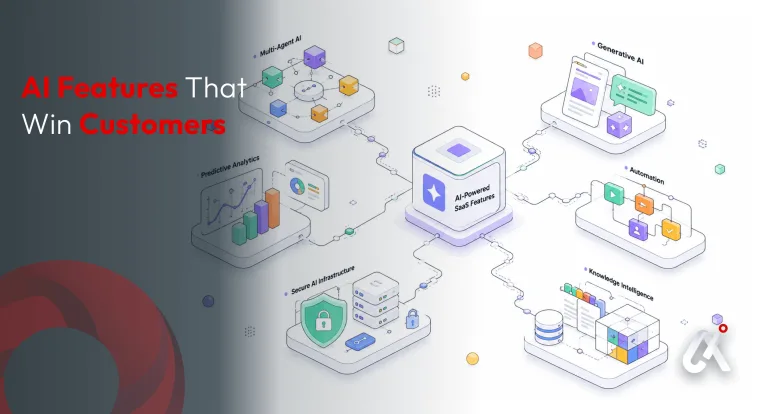
AI SaaS Features That Differentiate Your Product in 2026
The Software-as-a-Service (SaaS) industry in 2026 has crossed a critical threshold
-
Generative AI App Development: Transforming Web and Mobile in 2026
For forward-thinking CTOs, product managers, and enterprise decision-makers, staying competitive requires shifting away from legacy static architectures
-
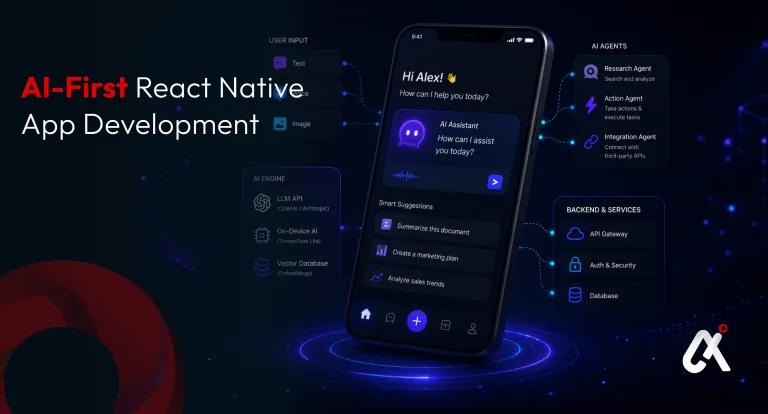
React Native AI: Building an AI-First Mobile App in 2026
A practical guide to AI-powered churn prediction, retention automation, and personalization for two-sided marketplace platforms